


A driveway can look beautiful all the way to the street, then fail where cars cross it every day. That street connection handles tire pressure, rain runoff, heat, and roadway movement. It can’t be treated like an ordinary patio border.
A well-built front apron gives your home a clean finished entrance and supports its broader outdoor living presentation. It also protects the base underneath and keeps water moving in the right direction. I have seen many driveways where the pavers looked fine at first, then the front row started sinking, spreading, or holding water after one wet season.
The best design begins with the street, the drainage, and the property line, not with the color of the paver.
Key Takeaways
- A driveway apron handles turning tires, braking, rain runoff, heat, and roadway movement, so it needs stronger planning than a typical patio edge.
- Confirm property lines, right-of-way rules, drainage paths, swales, culverts, and permit requirements before ordering materials or beginning street-side work.
- Traffic-rated concrete pavers, a properly excavated and compacted base, suitable joint sand, and firm edge restraint work together to prevent shifting and settlement.
- Plan the finished grade and water flow before installation, and inspect the apron regularly for loose pavers, missing joint sand, low spots, and washed-out areas.
What the street connection must handle in Florida
The paver driveway apron is the transition area between the street and your private driveway. On many Florida properties, part of that area may sit inside a public right-of-way, a swale area, or near a curb, sidewalk, culvert, or drainage inlet.
That means the apron has a harder job than the rest of the driveway. It must carry regular vehicle traffic without letting the pavers shift, while respecting the existing slope and drainage path.
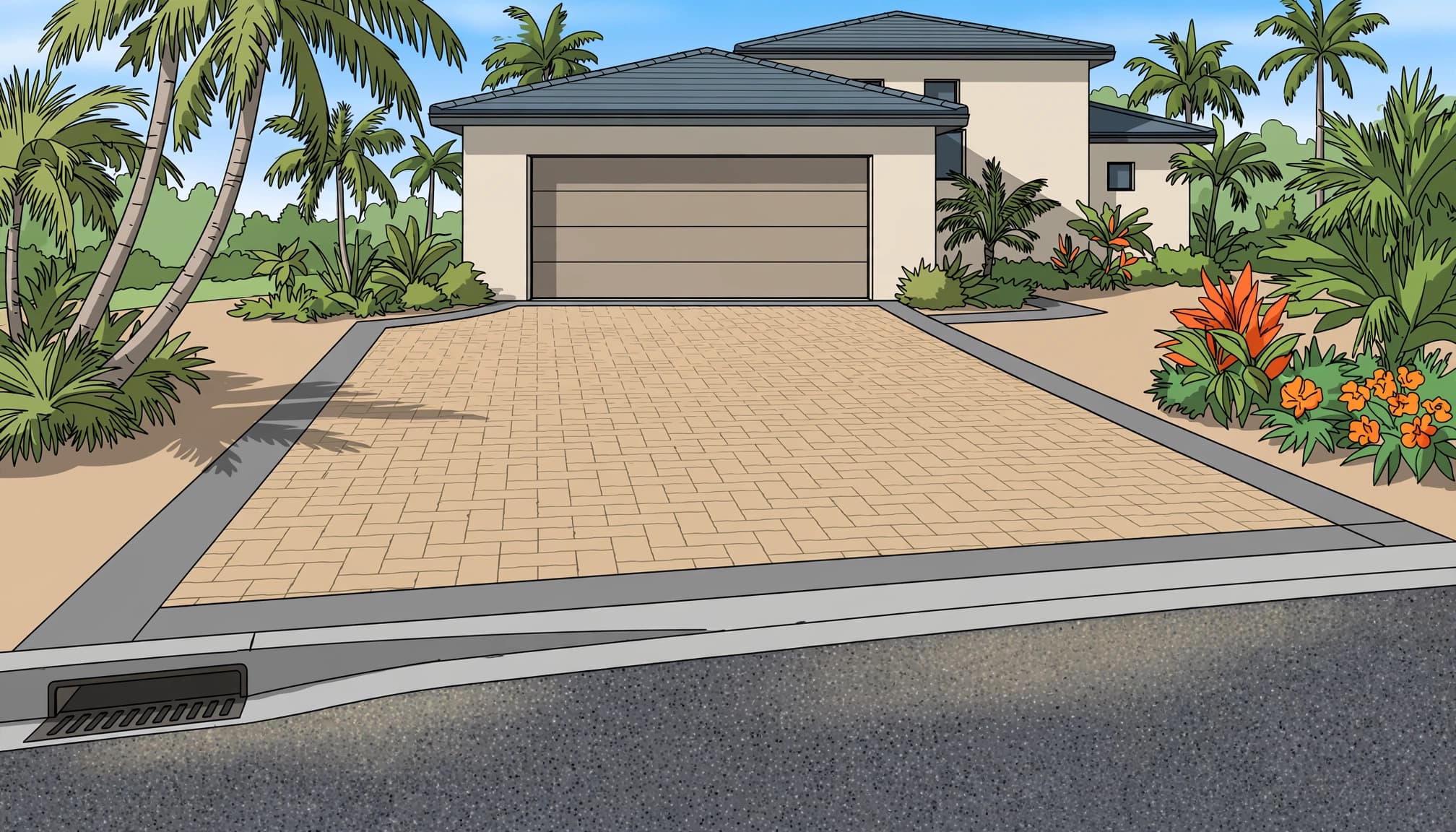
Street traffic puts pressure on the front edge
Cars don’t roll straight into a driveway every time. They turn, brake, accelerate, and sometimes enter at an angle. Those forces push outward on the pavers at the front of the driveway.
A weak edge restraint can start opening up. Once joints widen, sand escapes, water gets below the pavers, and the problem keeps growing. The outer border needs firm support, not a few loose pavers sitting against asphalt.
I look closely at the existing street edge, curb condition, driveway width, and how vehicles enter. A narrow entrance with sharp turns needs more attention than a wide, straight driveway connection.
Florida rain can expose poor design fast
Southwest Florida rain doesn’t always come down slowly. A short storm can send a lot of water across a driveway, through a swale, and toward the road.
If an apron is set too low, water can collect at the garage side. If it’s raised too high or built across a drainage route, water may back up in the swale. Both situations can lead to erosion below the pavers.
The surface can be level and still be wrong if the base is washing out below it.
Check right-of-way rules before choosing materials
I never recommend ordering pavers until the homeowner confirms where private property ends and public right-of-way begins. A driveway connection may be allowed on your lot but restricted at the street. Before ordering, confirm the property line, easements, swale, culvert, sidewalk, and drainage path.
The City of Fort Myers states that residential driveway construction requires an Engineering Division permit. This jurisdiction-specific example shows that the street connection isn’t always a simple cosmetic upgrade.
Rules change by city, county, and road owner
Fort Myers, Cape Coral, Bonita Springs, Punta Gorda, Sarasota, and unincorporated Lee County can all have different requirements. Requirements can vary by city, county, state agency, roadway classification, and project location.
For projects near a state-maintained route, review the FDOT permitting process before work begins. This is a state-agency process, not a universal rule for every Florida road. If the driveway connects to a county road, the county may have its own application, drawing, inspection, or drainage requirements.
Some jurisdictions allow architectural pavers in the right-of-way under strict conditions. Others only allow them behind the property line. I always tell homeowners to get the local answer for their address, rather than rely on what worked for a neighbor.
Drainage drawings may be part of approval
A permit review may require a survey or site plan showing property lines, swales, easements, drainage direction, sidewalks, culverts, and proposed connection dimensions. Ask the reviewing authority what documentation applies before work begins.
This isn’t paperwork for paperwork’s sake. A driveway connection can block the route where water is supposed to travel. In Florida, drainage problems can lead to standing water, soft soil, mosquito concerns, or disputes with the city.
As one jurisdiction-specific example, Lee County’s driveway administrative code says pavers placed next to flexible pavement require a concrete header curb. That local rule isn’t universal, but it shows why the asphalt edge alone may not provide stable restraint.
Choose pavers made for driveway use
A driveway apron needs pavers rated for vehicle traffic. Thin decorative units that may work for patios and walkways are not the right product at a street connection.
Concrete pavers are the most common traffic-rated choice for Florida driveways because they come in many colors, shapes, and finishes. Concrete pavers are practical to repair after utility work or settlement, with design flexibility for many paver styles. Porcelain pavers may suit some driveways, but their traffic rating, installation system, base, and local approval must support vehicle loads.
A practical choice for most aprons
Modern pavers often have small nubs on their sides. These create consistent joints between units, leaving space for joint sand and helping the pieces interlock.
For a driveway, I like pavers with a shape and thickness made for traffic. Follow the manufacturer’s traffic classification and approved local design, rather than choosing only for the home’s exterior color. A wide driveway with trucks, trailers, or frequent service vehicles may need a stronger design than a two-car household driveway.
Florida sun will cause some color fade in colored pavers over time, especially with darker paver styles. That is normal weathering. I tell homeowners to choose a blend that suits nearby outdoor living spaces and the home’s broader hardscaping plan.
Brick and stone have different tradeoffs
A clay brick paver system has a classic look, holds color well, and may limit choices or cost more. It also needs the same strong base and edge support as other driveway materials.
Natural stone can look elegant, but bluestone and granite are usually more expensive and may need more cutting. With bluestone, check thickness, finish, and slip resistance for driveway use, since requirements may differ from pool decks.
Good paver durability depends on the entire system, not only the surface material. For most Southwest Florida homes, a quality concrete system gives the best balance of appearance, repair access, and cost control. The best-looking material won’t stay beautiful if the base below it is weak.
Build the base before laying a single paver
The visible paver is only the top layer. Proper paver installation begins with a prepared base, not the visible unit. Long-term strength comes from excavation, stable soil, compacted aggregate, bedding sand, joint sand, and proper edge restraint.
A front apron is not the place to save money by reducing base depth or skipping compaction. That mistake may not show right away. It usually appears after rain, traffic, and time.
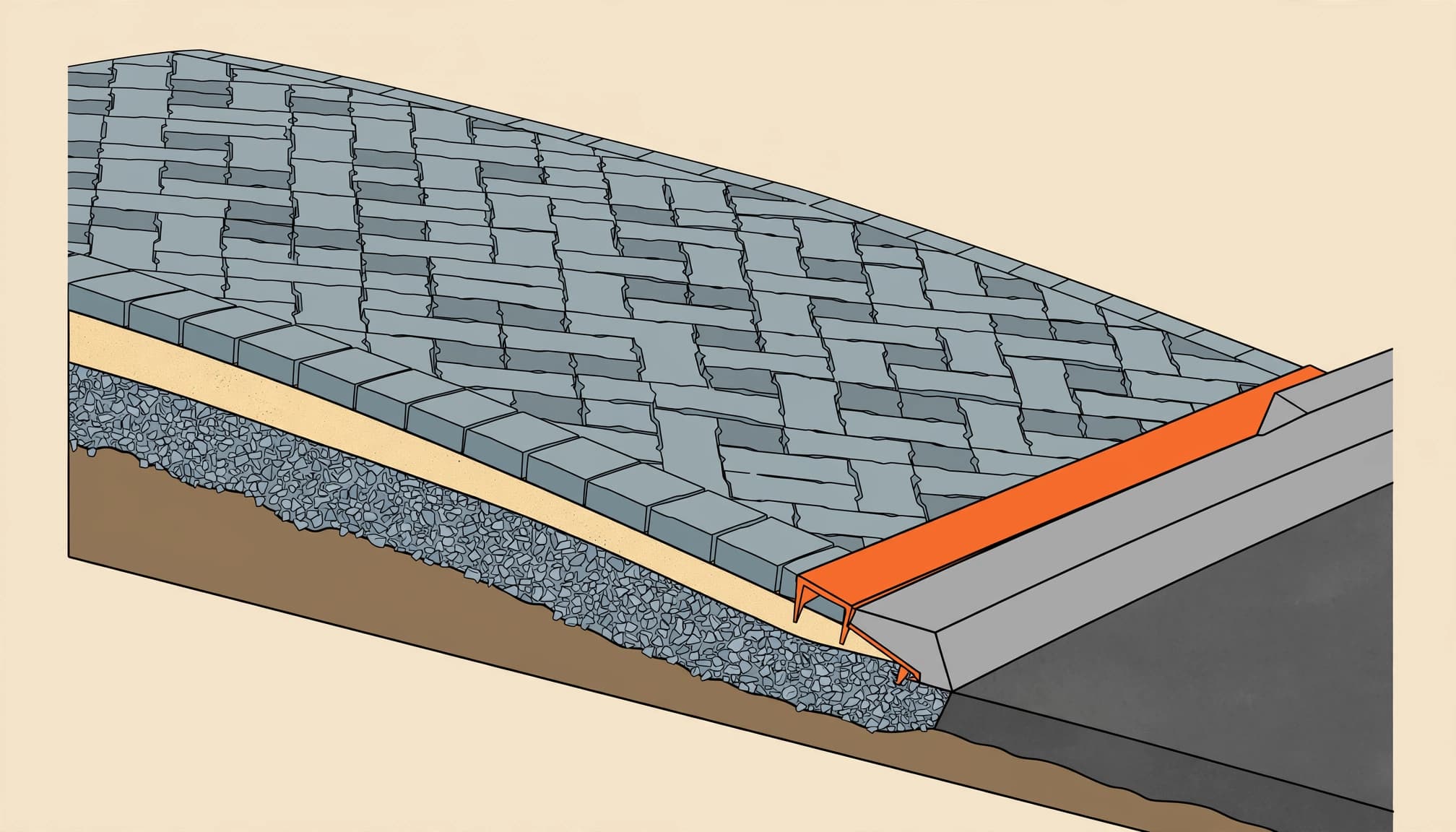
Compaction happens in layers
The old surface and unstable soil should be removed to the planned depth. The required base depends on soil conditions, traffic, roadway conditions, the approved design, and local requirements.
Aggregate is installed and compacted in controlled lifts. It should not be dumped in all at once and pressed down at the end.
Bedding sand is used to set the pavers to final grade. It is not a fix for a soft or uneven base. Adding loose sand under a sinking paver may make it look better for a short time, but it does not replace compacted aggregate that has washed out.
Geotextile fabric can help separate sandy subgrade from the base on certain properties. It is useful where soil conditions call for it, but it is not a substitute for excavation, proper stone, or compaction.
Edge restraint keeps the pattern locked
Every paver field wants to move outward under vehicle traffic. A solid perimeter restraint holds the layout together, especially at the street-facing edge and both sides of the apron.
The appropriate restraint depends on soil, traffic, roadway conditions, paving material, the approved design, and local requirements. Where applicable, an approved design may call for a concrete header curb or another heavy-duty edge restraint.
I also check utility locations before digging. Call 811 before excavation. Irrigation lines, electric, cable, water, and drainage pipes can all be close to a driveway connection.
Use a pattern that can take turning tires
Paver patterns are not only about style. They affect how traffic loads move across the surface and how many cuts are needed at the edges.
For a driveway apron, I usually favor an interlocking layout over a simple straight-running pattern. Interlocking pavers suit turning tires and braking forces. Performance also depends on the product, base, edge restraint, joint condition, and installation quality.
Herringbone pattern suits many driveways
A 45-degree or 90-degree herringbone layout locks pavers together in several directions. With a proper base, edge restraint, and sound joints, a herringbone pattern can resist shifting under braking and turning.
A running bond pattern can look clean and require fewer cuts in a straight driveway. Still, its long continuous joints may not be my first choice at a busy street connection. A basket weave pattern can create a traditional appearance, though its performance depends on the paver product and installation details.
Curves, circles, and decorative borders can connect the driveway to the home’s exterior and outdoor living areas. They also increase cutting, labor, and material waste. I like using a border where it frames the driveway without making the street connection too busy.
Order enough pavers for cuts and future repairs
Measure the apron’s length and width, then multiply them for square footage. For illustration only, a 14-foot-wide apron extending 8 feet deep equals 112 square feet. That example isn’t a required apron dimension.
The cutting allowance varies with the layout, borders, curves, edge cuts, and supplier packaging. Confirm the coverage guidance with your supplier before ordering, especially for detailed designs.
| Layout type | Cutting allowance to confirm |
|---|---|
| Straight running bond | Often lower, depending on edge cuts |
| Herringbone with straight edges | Moderate, depending on the layout and product |
| Curves, borders, and detailed cuts | Often higher, depending on the design |
Keep a few unopened pavers for later repairs. Color batches can vary, and an exact match may be difficult years down the road.
Plan water flow before the finished grade is set
A well-planned apron should direct water away from the house without creating a dam at the curb or swale. That depends on accurate elevations and a clear drainage route.
I inspect the driveway after rain when possible. Standing water, worn soil, algae marks, exposed roots, and washed-out joints show where water already wants to go.
Don’t block a swale or culvert
Many Florida homes depend on front-yard swales to move surface water. Filling, flattening, or bridging one carelessly can stop drainage and create trouble for the whole lot.
Coordinate the apron with the existing swale, drainage route, and surrounding yard through landscape design. Landscape design can’t override a required drainage path.
The driveway may need a culvert or a permitted connection detail. It may also need to tie into an existing sidewalk or curb at a required elevation. Make these decisions before the base is installed.
A county right-of-way permit example shows how driveway work, utilities, and public property can fall under one review process. It illustrates a permitting concept and may not represent Southwest Florida requirements. Confirm local rules before street-side work begins.
Keep roof water away from the paver edge
Downspouts shouldn’t dump directly beside the apron. Fast roof runoff can carve channels into the sand and base, causing low spots near the house or driveway edge.
Extensions, gutters, drains, or a revised grading plan may be needed before the pavers are set. If water is already sitting near the driveway after storms, fix that condition first. Proper drainage also helps keep outdoor living areas usable after rain.
New pavers shouldn’t cover an old drainage problem.
Maintain the apron without damaging the joints
The street-facing apron doesn’t need complicated care, but regular paver maintenance helps protect the appearance and usability of your home’s outdoor living areas. I recommend looking at the front edge after heavy rain and a few times each year.
Watch for loose pavers, missing joint sand, widening gaps, low spots, moving borders, and water that remains after the surrounding pavement dries.
Clean carefully and replace lost joint sand
Pressure washing can remove dirt, algae, and stains, but excessive pressure can chip the paver face and blast sand out of the joints. That sand helps keep the pavers locked together.
After cleaning, replace missing joint material with the right polymeric sand when appropriate. It helps stabilize sound joints and reduce weed growth, but it can’t correct a failed base, washed-out bedding layer, or broken edge restraint.
If a section keeps sinking, I lift the affected pavers, inspect the base, correct the cause, compact the area, and reset the surface. Replacing only the top paver is often a temporary patch.
Frequently Asked Questions
What is a driveway apron?
A driveway apron is the transition area where a private driveway connects to the public street. It carries vehicle traffic while also managing the change in grade, drainage, and edge conditions near the roadway.
Do I need a permit for a paver driveway apron in Florida?
Permit requirements vary by city, county, road owner, and project location. The work may involve a public right-of-way, swale, culvert, sidewalk, or drainage route, so confirm the requirements with the local authority before construction.
Which pavers and patterns are best for a driveway apron?
Use pavers rated for vehicle traffic rather than thin decorative units intended for patios or walkways. Interlocking layouts such as 45-degree or 90-degree herringbone can suit turning and braking forces when installed over a proper base with adequate edge restraint.
How do I prevent driveway apron pavers from sinking or spreading?
The installation needs stable soil, a properly excavated and compacted aggregate base, suitable bedding sand, sound joints, and firm perimeter restraint. Correct drainage is also essential because water washing through the base can cause settlement even when the surface initially looks level.
How should I maintain a paver driveway apron?
Inspect the front edge after heavy rain and watch for loose pavers, missing joint sand, widening gaps, low spots, and standing water. Clean carefully, replace lost joint material when appropriate, and correct the base or drainage problem instead of only resetting the visible paver.
A strong street connection starts below the surface
The street connection should look welcoming, but it must work harder than the rest of the driveway. The correct permit path, drainage plan, traffic-rated pavers, compacted base, and firm edge restraint all matter.
After more than 20 years working with Florida pavers, I know the small front section near the street can decide whether a driveway stays level or starts failing early. A solid base and proper drainage are never optional details. Together, drainage, appearance, and access support outdoor living around the property.
If you are planning a driveway in Fort Myers, Cape Coral, Bonita Springs, Punta Gorda, Sarasota, or nearby areas, Get a Free Quote and I can review the street connection, drainage, layout, and paver options before the work begins.