


A recreational vehicle or boat can be a dream purchase until it has nowhere solid to sit. If you’re comparing paver parking pads Florida contractors install, remember that permeable pavers are only one part of a complete parking pad system.
Florida rain, sandy or unstable soils, groundwater, intense sun, and heavy wheel loads all test a parking pad. I have seen beautiful pavers fail when the base, edge restraint, or drainage was treated as an afterthought. Properly designed permeable pavement systems give your RV or boat a stable place to park while directing water safely. Start with the site, not the color chart.
Key Takeaways
- Permeable pavers are only one part of a durable Florida RV or boat parking pad; the subgrade, aggregate base, drainage, edge restraints, and compaction determine long-term performance.
- Vehicle weight, wheel paths, trailer turning, stabilizer jacks, and soil conditions must be evaluated before selecting the pad design or material.
- High groundwater, saturated soils, and heavy rainfall may require an underdrain, partial detention, or another approved stormwater outlet instead of full infiltration.
- Permit requirements vary by municipality, so confirm local building, zoning, stormwater, driveway, and right-of-way requirements before installation.
- Regular sweeping, joint maintenance, and prompt inspection of standing water or settling help preserve water infiltration and surface stability.
Why Florida RV and Boat Pads Need More Than a Flat Surface
Florida yards often look level, but drainage and soil support can still vary across the site. Heavy rain can move soil and soften the subgrade, so permeable pavement systems must account for changing conditions. An RV adds concentrated wheel loads, while a boat trailer can twist the surface during tight turns and backing.
Permeable pavers are a good choice because individual units can be lifted and reset if a section settles. That repair access is a real benefit, but pavers aren’t magic. If the subgrade soil keeps moving, replacing the top units only hides the problem for a short time.
I look at where roof water lands, how the trailer enters, and whether tires, stabilizer jacks, or other equipment will sit on the pad. Those details shape how permeable pavement systems are planned, including the base, layout, drainage, and edge support.
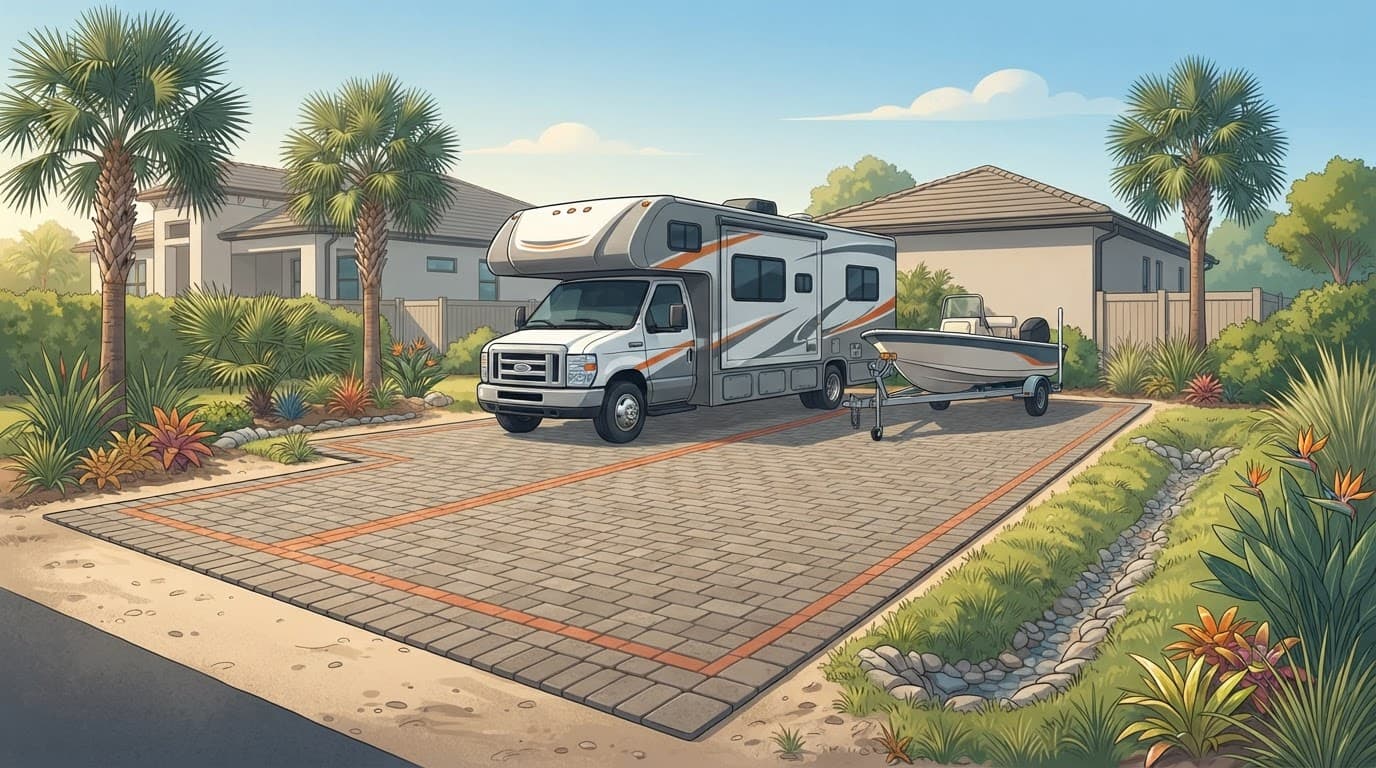
A properly planned pad gives recreational vehicles a stable surface while helping manage heavy Florida rainfall.
Heavy-Load Paver Pads Florida Homeowners Can Rely On for RVs and Boats
Can pavers support a large camper van, fifth-wheel, or boat trailer? Yes, when the full pavement system is designed for the vehicle’s load capacity. The finished permeable pavement system, not a paver product alone, determines performance.
Load capacity starts with the vehicle
Before I recommend a material, I want to know the RV’s gross vehicle weight rating, axle count, loaded trailer weight, wheel paths, and turning pattern. A pad suitable for a small travel trailer isn’t automatically adequate for a fifth-wheel or large motorhome. Heavy duty wheel loads and trailer demands may require a different design.
Boat trailers create their own loading concerns. Their tires may follow narrow paths, and the tongue jack can place a concentrated load in one small area. If you plan to use leveling jacks or stabilizers, tell the contractor before installation. Those point loads may change the required load capacity and require additional base support.
There isn’t one universal rating for every residential parking pad. The correct capacity depends on the vehicle, soil, aggregate depth, compaction, paver thickness, and expected use.
Permeable pavers and geo grid are different systems
Vehicular-rated units are commonly produced in 80 mm thicknesses. Products such as Nicolock Eco-Ridge and Eco-Tre are examples of concrete pavers used for vehicle traffic, but the product alone doesn’t determine the finished pad’s capacity.
That grid reinforcement differs from vehicular-rated paver units and a gravel grid. A gravel grid uses a plastic structure filled with gravel, which can help reduce rutting and support ground stabilization for occasional parking. Grid size, gravel fill, edge confinement, soil conditions, and vehicle weight all matter.
A grid system may be a practical choice for occasional parking. For a finished residential area where you turn, walk, wash, and regularly access an RV or boat, engineered permeable pavement systems with interlocking concrete pavement usually provide a cleaner, more repairable surface.
The Engineered Layers Under a Permeable Parking Pad
Permeable pavement systems combine permeable pavers with engineered stone, rather than placing a thin paver layer over loose material. Rainwater moves through the joints into the stone base, supporting water infiltration or movement to an underdrain for stormwater management.
The UF/IFAS permeable pavement guide explains the design, installation, drainage, and maintenance factors used with permeable pavement systems and interlocking concrete pavement.
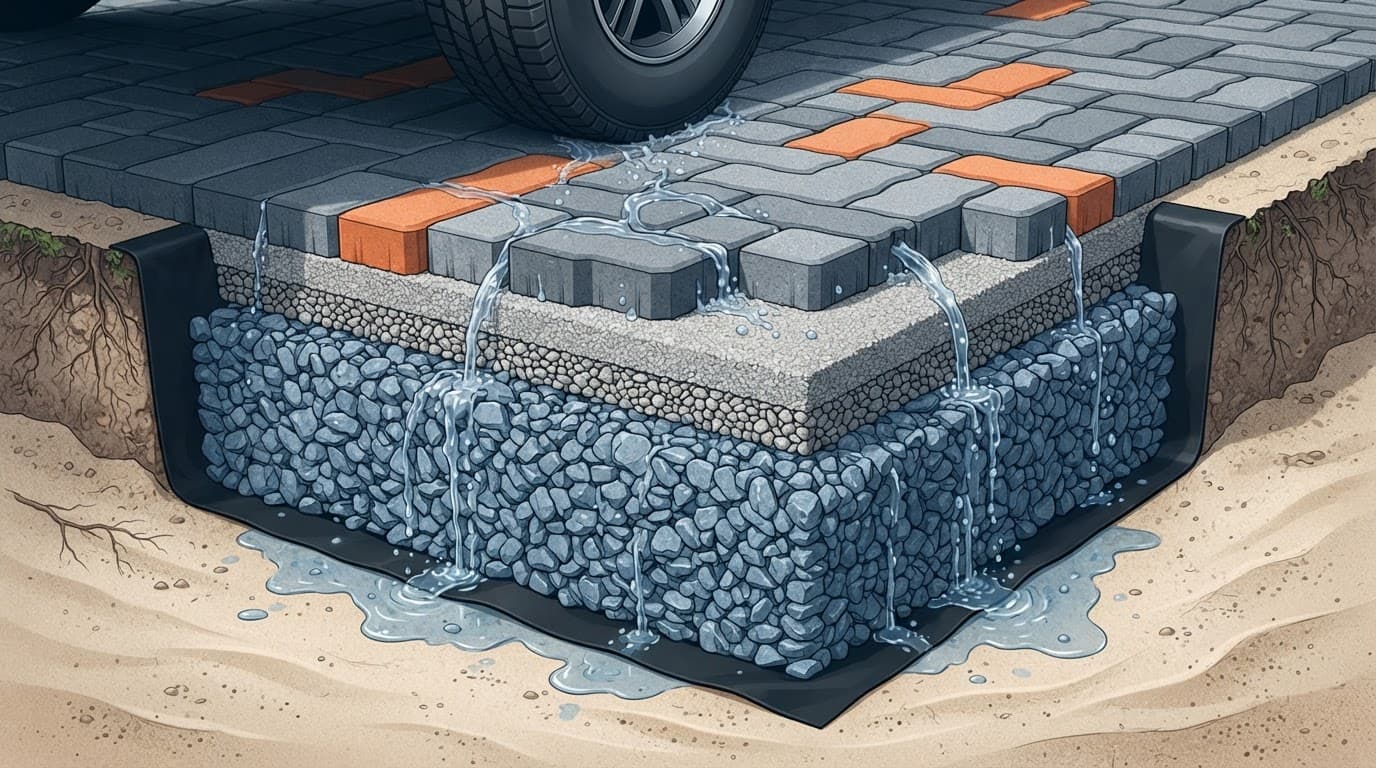
What goes below the pavers?
A properly designed profile may include several layers:
- The surface uses vehicular-rated permeable pavers with open joints that let water pass between units.
- The joints contain a clean, specified aggregate rather than ordinary fine sand that can block the openings.
- A bedding course supports the pavers and keeps the surface level.
- The aggregate base uses open-graded stone to support the pavers and store water below the pad. This reservoir base coarse means the open-graded stone reservoir layer.
- A geotextile or geo grid may be included where soil separation or reinforcement is needed.
- The prepared subgrade soil provides final support and controls how quickly water leaves the system.
The exact thickness of each layer depends on vehicle loading, soil testing, stormwater volume, groundwater, and local requirements. A pad for an occasional boat trailer may not need the same profile as one used by a large motorhome every day.
High water tables change the profile
Permeable pavement systems need room below the stone base to drain. UF/IFAS guidance places the bottom of a full-infiltration system at least 2 feet above the seasonal high-water table. It also identifies a minimum saturated hydraulic conductivity of 2 inches per hour for subgrade soil when aggregate is installed.
The reservoir base coarse, meaning the open-graded stone reservoir layer, should be sized for drainage efficiency and complete emptying within roughly 24 to 72 hours. If the subgrade soil stays saturated, the design may need an underdrain, partial detention, or another approved outlet.
A permeable surface cannot fix a pad built over a constantly saturated base.
Southwest Florida properties can have shallow groundwater, especially in low-lying areas. I never promise that a full-infiltration design will work without checking site conditions first. The high-water-table design criteria also explain why groundwater separation matters to permeable pavement performance.
Stormwater Management and Florida Permits
Stormwater management is not an extra feature on an RV or boat pad. It protects the home, the pad, neighboring properties, and the soil around the installation.
Properly designed permeable pavers can accept ordinary rainfall and store it below the surface. Permeable pavement systems reduce surface runoff by allowing water to enter the base instead of rushing across the yard. During extreme storms, excess surface runoff needs a safe route away from the foundation and property line. Roof downspouts need safe outlets away from the paver edge and foundation to prevent soil erosion near the trailer path.
The Florida DEP stormwater program provides the statewide framework, but local review can add requirements. A retention design using permeable pavement systems may qualify for certain stormwater pollutant-load reduction credits. A system with an underdrain sends water toward an outlet and may not receive the same credit. Sustainability or green-building credits also depend on the certification program and documented design.
Approval depends on the municipality
Permit requirements vary between Fort Myers, Cape Coral, Lee County, Bonita Springs, Punta Gorda, Sarasota, and nearby communities. A parking pad may involve building, zoning, stormwater, driveways, or right-of-way review.
Cape Coral guidance for permeable pavers calls for items such as a permit application, product and manufacturer information, a survey, tree locations near the project, and a maintenance plan. Utility locating through 811 is also part of responsible preparation. Excavation in the right of way requires separate attention.
I recommend checking the local building department before materials arrive and confirming current requirements for your municipality. An unapproved change can create drainage trouble, inspection delays, correction costs, and problems when you sell the home.
Choosing a Surface and Planning the Cost
Water-friendly paving options include porous asphalt and porous concrete, commonly called pervious concrete. The latter uses a continuous open mix, so it isn’t ordinary concrete. These permeable pavement systems use different structures to manage runoff, as explained in the porous pavement fact sheet.
Here are broad planning estimates, not guarantees, for different surface materials:
| Surface | Broad planning estimate | Common fit |
|---|---|---|
| Porous asphalt | About $3 to $7 per sq. ft. | Larger areas, parking lots, and lower upfront budgets |
| Porous concrete | About $8 to $18 per sq. ft. | A continuous concrete appearance |
| Permeable pavers | About $12 to $26 per sq. ft. | Residential design, repair access, and flexible layouts |
UF/IFAS lists about $7 to $16 per square foot for permeable interlocking concrete pavement. Local residential work can cost more with deep excavation, difficult access, greater aggregate depth, or drainage needs. Permits, decorative borders for curb appeal, and an underdrain can also materially change the price. Local porous asphalt pricing varies with these site conditions and project details.
The best paver parking pads Florida homeowners install are priced around complete permeable pavement systems, not the pavers alone. Pad size, aggregate materials, soil conditions, and vehicle weight all affect the final estimate. Heavy duty RV or boat use, drainage, edge restraints, pattern, and access matter too.
A professional site visit gives you a better number than an online calculator. You can Get a Free Quote for professional installation services and a site evaluation in Southwest Florida before choosing a material.
Installation Details That Protect the Parking Pad
A long-lasting pad begins before the first paver is placed. When preparing permeable pavement systems, I pay close attention to excavation, subgrade preparation, compaction, water flow, and tire-turning areas.
Prepare and compact in controlled stages
The crew should mark utilities, remove unsuitable material, establish finished elevations, and properly prepare the subgrade soil. Soft areas need correction before the stone base is installed.
The reservoir base coarse is an open-graded stone layer that stores and distributes water beneath the pad. The aggregate base is placed in measured lifts and compacted properly, not simply dumped and rolled across the top. Support must remain consistent beneath RV wheel paths and trailer turning areas, where heavy duty traffic creates concentrated forces.
Geotextile can separate the aggregate from sandy or unstable soil when the design calls for it. A geo grid may add reinforcement, but it doesn’t replace correct excavation, drainage, or compaction. A gravel grid serves a different role and isn’t a substitute for reinforcement within a full paver system.
Finish the edges, slope, and access
Edge restraints keep pavers from spreading when the RV turns or the trailer backs into place. Without firm edges, joint openings grow and the surface can begin to move.
Finished elevations and slope should direct water away from the home, not toward a neighbor. For permeable pavement systems, I check clearance around fences, screen enclosures, landscaping, utility boxes, walkways, and overhead obstructions. I leave service clearance for future maintenance, since a sound pad can still frustrate drivers when access is tight.
Maintenance That Keeps Water Infiltration Working
Permeable pavers need regular maintenance so their openings stay clear. Leaves, sediment, mulch, grass clippings, and fine soil can fill the joints and slow water infiltration.
Sweep the pad after storms and remove organic debris before it settles into the openings. Watch the low edges after heavy rain. If water remains unusually long, sediment may have accumulated or the base may not be draining correctly.
Clean without damaging the joints
For permeable pavement systems, soap and water are often enough for ordinary dirt and help preserve performance. A thick crust of dust, algae, or grime may need controlled pressure washing, but aggressive cleaning can chip pavers and blow joint material out of the gaps.
If pressure washing is needed, I use the lowest effective setting, a broad fan tip, and a small test area first. A zero-degree nozzle aimed at one joint can do more damage than the stain. Keep the wand moving and avoid forcing water directly into open joints.
Refill the correct joint material
After cleaning, inspect the joints. Missing material leaves pavers less supported and gives weeds, debris, and runoff more room to enter. Standard interlocking pavers may use polymeric sand when the product and installation allow it.
Permeable pavers are different. Fine sand or the wrong binding product can clog the drainage openings, so use the aggregate recommended by the paver manufacturer. Sealer also needs care. A coating that closes the joints or reduces infiltration can defeat the reason for choosing a permeable surface.
Recurring rocking pavers, low spots, spreading borders, open joints, or standing water require maintenance beyond the surface. These symptoms call for a base and drainage inspection rather than more material on top. I check the full section when problems return, because the visible issue is often not the original cause.
Frequently Asked Questions
Can permeable pavers support an RV or boat trailer?
Yes, when the complete pavement system is designed for the vehicle’s weight and use. The paver thickness, aggregate depth, soil support, compaction, edge restraint, and turning loads all affect the finished pad’s capacity.
How deep should an RV or boat parking pad be?
There is no universal depth because the required profile depends on vehicle loading, soil conditions, rainfall, groundwater, and local requirements. A site evaluation and soil assessment should determine the thickness of the bedding, open-graded aggregate base, and any additional reinforcement or drainage layers.
Do permeable pavers solve Florida drainage problems?
They can help manage ordinary rainfall by allowing water to move through the joints into the aggregate base. However, saturated soils, shallow groundwater, roof runoff, or extreme storms may require an underdrain or another approved outlet.
Are permits required for a permeable RV or boat pad in Florida?
Permit requirements vary between municipalities and may include building, zoning, stormwater, driveway, or right-of-way review. Check with the local building department before excavation and confirm whether a survey, maintenance plan, product information, or utility locating is required.
How do I maintain permeable pavers?
Sweep away leaves, sediment, mulch, and grass clippings so the joints remain open for water infiltration. Use the manufacturer’s recommended aggregate when refilling joints, avoid clogging sealers, and investigate recurring standing water, rocking pavers, or low spots.
A Durable Pad Starts Below the Pavers
A Florida RV or boat pad needs more than attractive concrete pavers. Permeable pavers are only the visible surface. Durable performance depends on vehicle demands, the soil profile, structural layers, edge restraint, water routing, and a realistic care plan. Some sites may also need an open-graded reservoir layer, such as reservoir base coarse, or an underdrain for outlet-based drainage.
For Florida homeowners, evaluate the vehicle, site, and long-term care plan before choosing a color. Permeable pavement systems perform best as a complete assembly, with stormwater management planned from the start. The result is a stable, practical parking area that remains easier to repair over time.