


Florida rain can expose a driveway problem in minutes. A properly designed permeable paver driveway gives water somewhere to go instead of sending each storm toward your garage, street, or neighbor’s property. I like this permeable system for many Southwest Florida homes, but its performance depends on the soil, slope, and layers beneath the pavers. The paver surface is visible, but the real work happens below it.
Key Takeaways
- A permeable paver driveway can reduce puddling and stormwater runoff by allowing water to pass through its joints into a stone reservoir below.
- Site conditions come first: soil infiltration, finished slope, seasonal high water table, grading, downspouts, and neighboring runoff all affect performance.
- The stone base, bedding aggregate, joint material, geotextile fabric, edge restraints, and compaction are just as important as the pavers themselves.
- Permeable pavers offer design flexibility and easier spot repairs than pervious concrete, but costs can increase with excavation, drainage corrections, difficult access, or deeper base requirements.
- Regular inspection, debris removal, joint maintenance, and compatible cleaning products help preserve the system’s drainage performance.
Why a Permeable Paver Driveway Fits Florida Rain
Traditional concrete and asphalt create impervious surfaces. Rain hits these surfaces, runs across them, and carries dirt, oil, and debris toward drains or low areas as stormwater runoff. Permeable pavers change that path, creating a type of pervious pavement designed to let water pass through. Water moves through wider joint gaps into layers of clean stone, where some infiltrates into the soil.
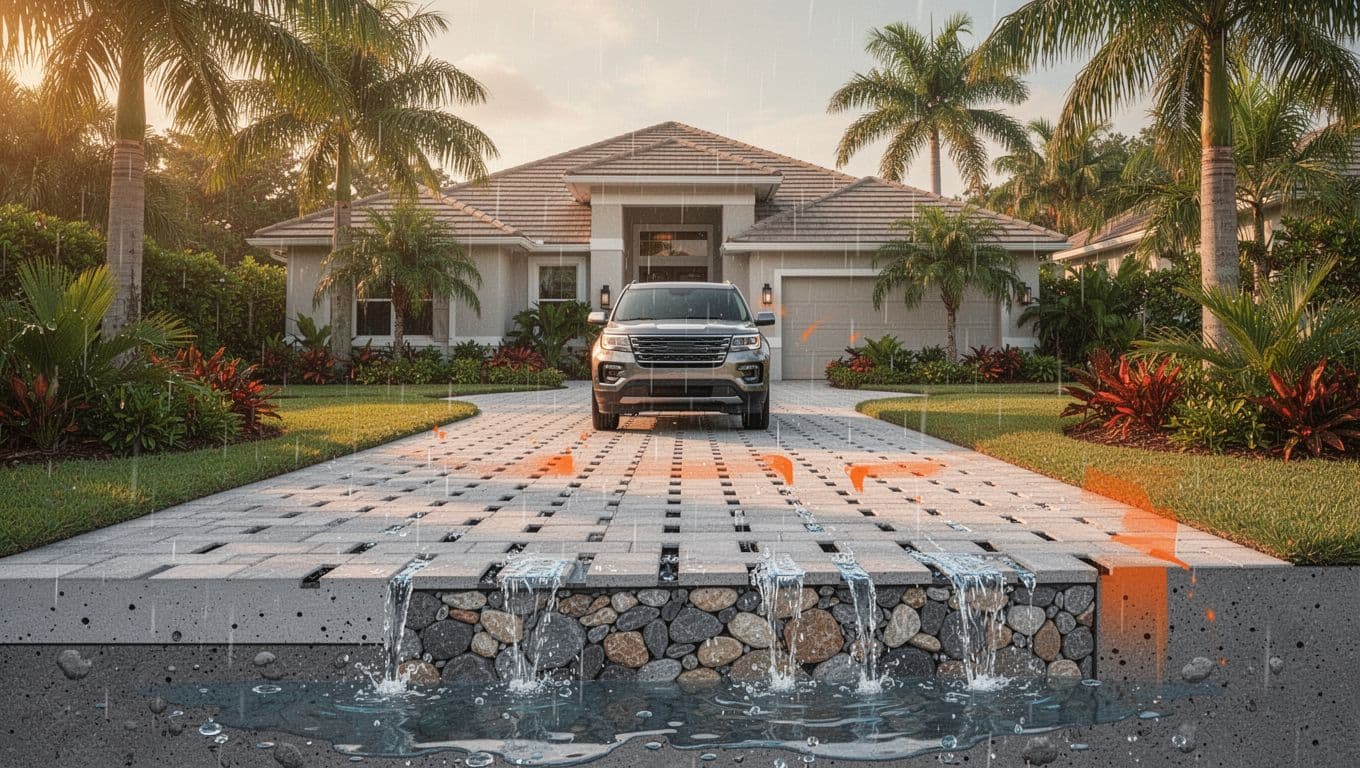
This can reduce surface puddling, soil erosion, and stormwater runoff around the home. It can also reduce the amount reaching the street during heavy storms. Where soil and water-table conditions allow, some of that water may support groundwater recharge.
The UF/IFAS technical guidance on permeable pavement explains that the full system must be designed for drainage, soil conditions, installation, and long-term maintenance.
A permeable surface isn’t a magic answer for every wet driveway. If the seasonal water table is close to the surface, the soil drains poorly, or a neighboring property sends water downhill, the pavers alone won’t solve the issue. I inspect the entire drainage path before recommending this type of driveway.
For Florida homeowners, the biggest advantage is flexibility. Individual pavers can be lifted and replaced, colors and patterns can match the rest of the property, and the surface doesn’t have to look like a commercial parking area. With quality installation, the driveway can be practical, attractive, and an eco-friendly choice that is easier to repair than one continuous slab.
Site Requirements That Prevent Drainage Problems
Drainage, slope, and soil come first
The first question isn’t which paver color you want. It’s where the water will go after it passes through the surface.
I look at the finished grade, garage elevation, property lines, roof downspouts, nearby pool areas, retaining walls, trees, and storm flow paths. Grading issues such as negative grading can direct water toward the house instead of away from it. An elevated neighboring lot can create the same issue by sending runoff onto your driveway.
The soil and subgrade need testing to establish a site-specific infiltration rate. UF/IFAS guidance identifies a minimum vertical saturated hydraulic conductivity of 2 inches per hour for systems that infiltrate through an aggregate base into the subgrade. That cited criterion is not a universal result for every property.
Review downspouts, neighboring grades, and other drainage paths for grading issues before excavation. The bottom of an infiltrating system should also sit at least 2 feet above the seasonal high water table. A system should drain completely within roughly 24 to 72 hours, not stay saturated under the pavers.
Finished slope matters too. Many design guides recommend keeping permeable pavement at or below a 5 percent slope. Some local Florida rules use a 1:12 limit for certain residential driveway conditions. Those are not the same measurement, so local requirements and the product specifications must be checked before construction.
If the subgrade cannot accept water quickly enough at the required infiltration rate, the design may need an underdrain, overflow route, or another stormwater feature. That decision belongs in the plan before excavation starts.
Build a reservoir, not a shallow gravel bed
The pavers are only the top of the system. Underneath, the driveway needs a stable, open-graded stone reservoir that holds water temporarily while supporting the subgrade and vehicle loads.
A lighter residential installation may use a base layer around 6 to 8 inches deep, but many Southwest Florida sites require a deeper stone section, often around 12 to 18 inches. The final depth depends on soil, drainage volume, load class, and local conditions. A thin layer of bedding stone, usually about 1 inch, supports the pavers above the main base.
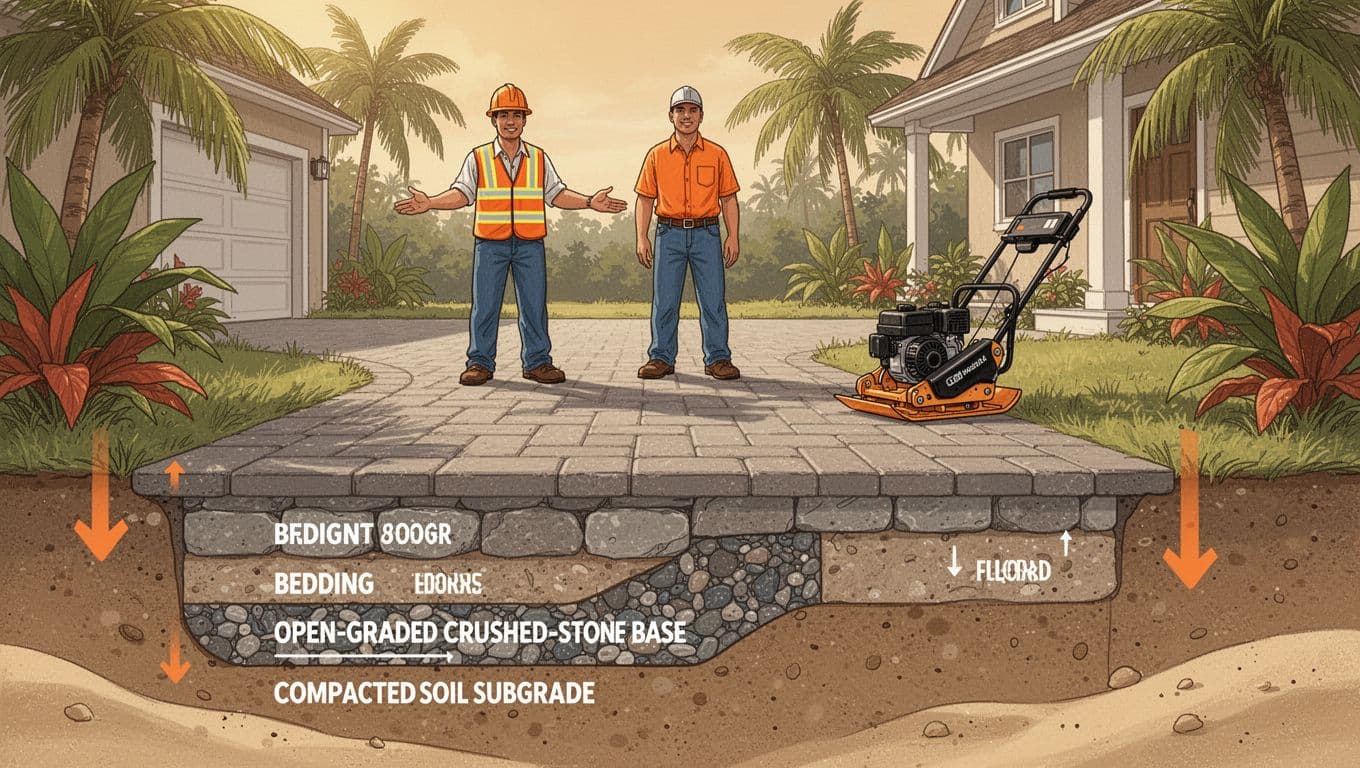
The stone should be clean, washed, and angular. Dusty material can fill the open spaces and slow infiltration. Geotextile fabric may be needed along the bottom or sides of the base to keep soil from migrating into the stone. Strong edge restraints keep the pavers from spreading under tire loads.
The joint gaps also need the right material. Many systems use a small washed angular aggregate around 1/4 to 3/8 inch, but the exact size must match the paver manufacturer. Ordinary fine sand can clog the openings and reduce drainage performance.
A new paver over a weak base is still sitting on a weak base. It may look better for a short time, then fail again.
Every base lift needs proper compaction. I don’t rush this part because settlement, rocking pavers, and standing water usually start below the surface.
Comparing Permeable Pavers, Pervious Concrete, and Porous Asphalt
These forms of pervious pavement manage water differently, and the best choice depends on the homeowner and property. Porous asphalt can suit larger areas, while pervious concrete provides a continuous appearance.
| Surface | Main drainage method | Typical installed cost | Best fit |
|---|---|---|---|
| Porous asphalt | Water passes through the asphalt structure | About $3 to $7 per sq. ft. | Larger areas and lower upfront cost |
| Pervious concrete | Water passes through the concrete mix | About $8 to $18 per sq. ft. | A continuous concrete appearance |
| Permeable pavers | Water passes between designed joints | About $12 to $26 per sq. ft. | Residential design flexibility and repair access |
The selected system should match the property’s intended load class and expected use. A grid system filled with gravel is a different construction approach, not automatically equivalent to an engineered permeable paver assembly.
These prices are broad market estimates, not a quote for your property. Demolition, excavation, access, base depth, drainage work, borders, and pattern selection can move the price higher. Retrofit projects with unstable soil or major drainage correction can reach $40 per square foot or more. Performance depends on both the stone structure and the subgrade.
Porous asphalt is often the least expensive choice, but its residential appearance and repair options are more limited. Pervious concrete looks clean and uniform, but repairs can be hard to blend; a pervious concrete patch may show color differences. Replacing larger sections can raise pervious concrete costs, while permeable pavers allow damaged areas to be lifted, corrected, and reset.
A residential system can handle normal cars and many occasional service vehicles when the base and paver thickness are engineered correctly. Heavy vehicle traffic needs a different conversation, since porous asphalt may need a thicker structural section. Moving trucks, RVs, trash trucks, and repeated delivery traffic may require a higher load class, thicker pavers, a deeper base, and a load-rated system. For anyone parking an RV, boat, or trailer, my paver parking pads Florida guide covers the base depth, paver thickness, and load requirements large vehicles demand. The Florida Department of Transportation permeable paver study is a useful example of why strength and drainage need to be evaluated together.
Freeze-thaw cycles aren’t the main concern in Fort Myers, Cape Coral, or most of Southwest Florida. The bigger concerns are intense rainfall, saturated soil, heat, root growth, and poor grading. Proper drainage still matters because trapped water can move the base, even when freezing temperatures are rare.
Florida Costs, Permits, and Stormwater Credits
For a new permeable paving project, Florida homeowners should expect a broader price range than a standard paver replacement. Current installation cost estimates commonly land in the low teens to mid-20s per sq. ft. Deep excavation, demolition, difficult access, high-water-table conditions, and drainage improvements can raise the total into the $40 to $60 per square foot range.
Before finalizing your budget, check whether a local rebate program may apply.
Ask for an itemized estimate that separates:
- Removal and disposal of the existing driveway.
- Excavation and soil preparation.
- Stone base depth and materials.
- Bedding aggregate and joint fill.
- Pavers, borders, and perimeter containment.
- Drainage connections, grading, or underdrains.
- Final cleaning and site restoration.
Permit requirements are local. A minor paver reset differs from replacing a full driveway, changing grades, modifying a swale, or connecting a drainage system. Those changes may require a building permit, especially when they create grading issues or alter stormwater runoff. I recommend checking with the city or county building department before work begins, particularly when the project affects a screen enclosure footer, right of way, stormwater easement, or neighboring drainage.
Sarasota County’s RainCheck rebate program has offered an incentive for pervious pavement replacement in impervious areas, including driveways. That rebate program may provide $5 per square foot, up to $5,000, for eligible properties in the county stormwater service area or the City of Sarasota. Applications are generally accepted between October 1 and June 1, and the county requires pre-application steps and a maintenance commitment.
Fort Myers has a stormwater utility credit for certain best management practices, including porous pavement. The credit applies to qualifying parcels within city limits and excludes property in the Six Mile Cypress Watershed. Program rules can change, so I would confirm current eligibility before including a credit in your budget. I would not rely on a rebate program without that confirmation. Cape Coral, Bonita Springs, and Punta Gorda homeowners should also verify local requirements directly.
Maintenance and Troubleshooting for Permeable Pavers
The maintenance requirements for permeable pavers are manageable, but regular care still matters. Leaves, soil, mulch, grass clippings, and construction dust can fill the joints over time. Once the openings clog, water moves across the surface instead of through it.
I recommend inspecting the driveway after major storms and sweeping or vacuuming about every three months in areas with heavy tree cover or loose soil. Remove debris before it washes into the joints. Keep roof downspouts from discharging directly onto one small section of the driveway. A local rebate program may require a maintenance commitment, so follow its inspection and cleaning terms.
The joint material helps the paver system drain properly. Replacing it with ordinary sand can reduce performance. If joints are low or empty, use the aggregate specified for the product. Sealer also needs caution. A standard film-forming sealer can close the openings, so I don’t apply one without confirming that the product is compatible.
Pressure washing can help remove dirt and algae, but too much pressure can chip the paver face and blow joint material away. I use a controlled cleaning process when needed, then restore the correct joint fill. Cleaning should not be used to hide a base failure.
Watch for these warning signs:
- Water remains in the same area well after a storm.
- Several pavers rock, sink, or sit lower than the surrounding surface.
- The border begins spreading outward.
- Soil or fine sediment keeps washing into the joints.
- Runoff arrives from an uphill neighbor or damaged downspout.
- Tree roots lift the driveway or push against the border support.
Pooling may come from clogged joints, a settled base, high groundwater, or negative grading. Adding loose material beneath one rocking paver is usually a short-term patch. The affected area may need to be lifted, cleaned out, rebuilt, and compacted in layers.
Tree roots need care as well. I don’t recommend cutting large roots blindly to force the driveway flat. The tree, drainage, edge support, and available space all need to be considered. If a screen enclosure is nearby, the pavers and concrete footing should be inspected together because they can move at different rates.
At Platinum Pavers of SWFL, I help homeowners in Fort Myers, Cape Coral, Bonita Springs, Punta Gorda, Sarasota, and nearby communities review the whole surface before recommending a repair or replacement. You can Get a Free Quote and have the pavers, base, grading, and drainage checked before a small issue becomes a larger project.
Frequently Asked Questions
Do permeable pavers work well in Florida?
They can work well when the soil, slope, groundwater conditions, and stone base are properly evaluated. A permeable surface alone cannot correct poor grading, a high water table, or runoff coming from a neighboring property.
How deep should the base be under a permeable paver driveway?
A lighter residential installation may use about 6 to 8 inches of base, while many Southwest Florida sites need roughly 12 to 18 inches. The correct depth depends on soil, drainage volume, vehicle loads, and local design requirements.
Are permeable pavers more expensive than standard paving?
Permeable pavers commonly cost more because they require excavation, open-graded stone, proper joint aggregate, and careful compaction. Deep base sections, demolition, difficult access, high groundwater, and drainage improvements can increase the total cost substantially.
How often do permeable pavers need maintenance?
Inspect the driveway after major storms and remove leaves, soil, mulch, and other debris before it clogs the joints. In areas with heavy tree cover or loose soil, sweeping or vacuuming about every three months may be appropriate.
Can ordinary sand be used between permeable pavers?
Ordinary fine sand can fill the openings and reduce drainage performance. Use the washed, angular joint aggregate specified by the paver manufacturer, and replace missing material with the correct product.
A Better Driveway Starts Below the Pavers
This permeable paver system can reduce puddling, improve stormwater flow, and give your Florida home a durable surface with plenty of design choices. It works best when soil, the high water table, slope, base depth, joint aggregate, and edge support are planned as one system.
The surface may be beautiful, but the foundation determines how long it lasts. With more than 20 years of paver experience, I know that careful preparation and honest recommendations matter more than rushing a project to the finish. A driveway built for Florida rain should look good on a dry day and perform properly after the next heavy storm.