


Bright orange spots after fertilizing your lawn are usually iron oxide, not ordinary dirt or organic stains. This guide explains how to remove fertilizer stains pavers safely, whether fresh marks remain on your patio pavers or have already set.
I have seen fresh fertilizer marks disappear with careful rinsing, but set discoloration often needs a masonry cleaner and controlled scrubbing. Baking soda may help certain residues, while chlorine bleach or strong acids can cause more damage than the original mark.
Key Takeaways
- Fresh fertilizer granules should be swept up and rinsed from pavers before moisture activates the iron and mineral residue.
- Orange stains are usually iron oxide and may require a paver-safe rust remover, gentle nylon brushing, and thorough rinsing.
- Avoid chlorine bleach, wire brushes, and untested acids, especially on limestone, travertine, marble, and other acid-sensitive stone.
- Use the lowest effective pressure-washing setting and protect joint sand from being blasted out.
- Prevent recurring stains by correcting runoff, keeping fertilizer off wet pavers, and sealing only clean, dry, stable surfaces.
What Causes Orange and White Fertilizer Stains?
Many granular fertilizers contain iron, often as iron sulfate or another iron compound. When those granules land on wet concrete pavers, clay brick, or stone, the iron reacts with air and moisture. The result can be familiar rust stains, usually red-orange or brown, but not every fertilizer causes them.
White powder is different. It may be fertilizer residue, lime, or efflorescence, a mineral deposit carried to the surface by moisture. On patio pavers, recurring white deposits may signal moisture-related efflorescence rather than leftover fertilizer.
Pavers form a porous surface, so moisture and fertilizer can enter patio pavers instead of staying on top. Residue may settle in small openings, joint edges, and textured clay, making a stain left for several days harder to identify.
Green or black biological marks are more likely organic stains, so they need a different diagnosis than fertilizer discoloration. Baking soda shouldn’t substitute for identifying the residue first.
Chlorine bleach does not remove iron rust. It can oxidize the iron further and make the orange mark harder to remove.
Before cleaning, identify the stain in daylight and test any product on an inconspicuous location, especially on natural stone. A stone patio may show similar discoloration, while a limestone patio may react differently because acid sensitivity varies by surface.
How to Remove Fertilizer Stains From Pavers Safely
For homeowners asking how to remove fertilizer stains pavers, I recommend this process. It supports paver stain removal, protects the paver face, and helps keep joint sand in place.
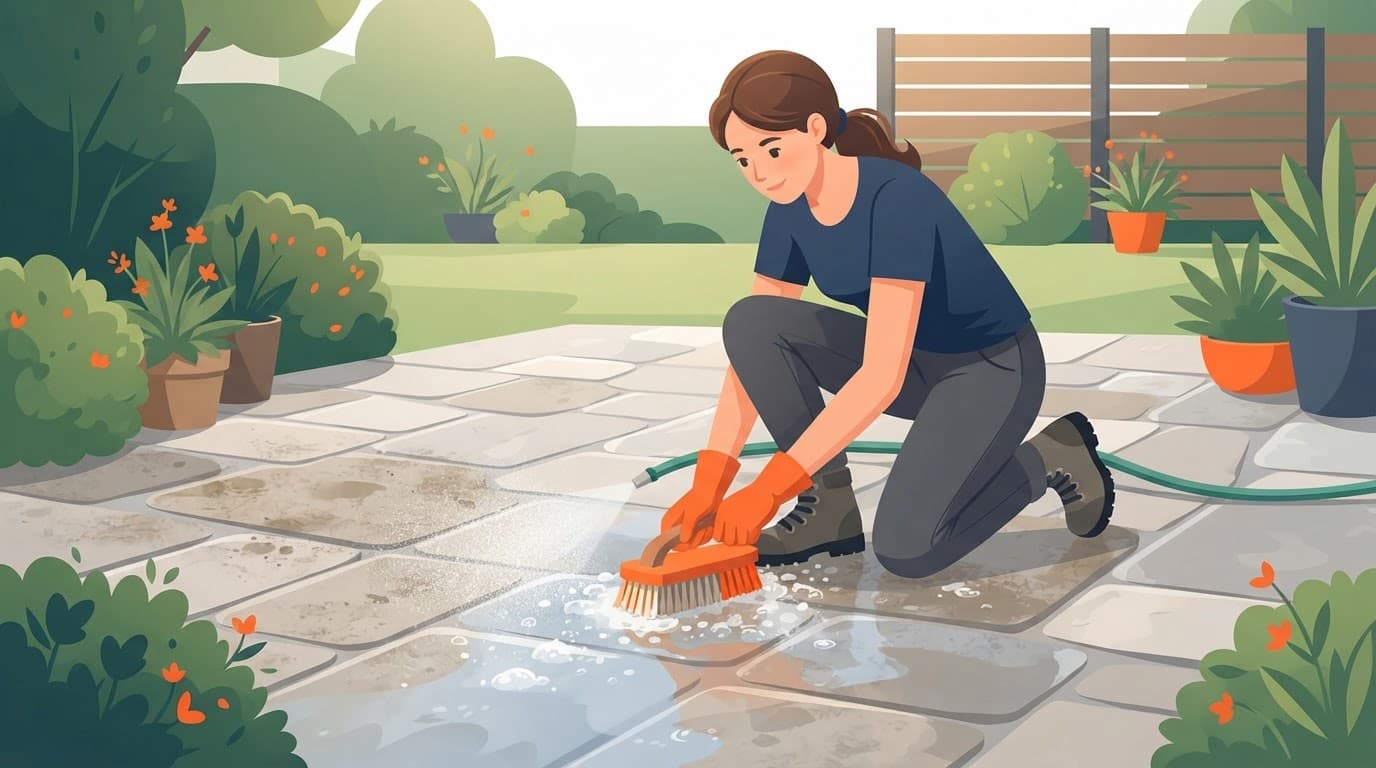
- Remove loose granules first. Sweep or vacuum dry fertilizer from patio pavers. Do not scrub fresh granules into wet pavers.
- Rinse the area with clean water. Flush the patio pavers and nearby joints, directing runoff away from grass, drains, and the pool. Fresh residue may lift without a chemical cleaner.
- Use a paver-safe rust remover for orange rust stains. Choose a commercial cleaner labeled for concrete or brick pavers, confirm compatibility with patio pavers, and test an inconspicuous area first. Many formulas use oxalic acid to break down iron oxide. Wear gloves and eye protection, provide ventilation, and follow the label directions. Products such as F9 BARC are examples of specialized cleaners marketed for rust and iron stains, but always confirm surface compatibility.
- Scrub with a nylon stiff-bristle brush. Work gently across the stain instead of using a metal wire brush. Wire bristles can scratch the paver face and leave behind tiny metal particles that create new rust marks.
- Rinse thoroughly and repeat if needed. Do not mix cleaning products. Follow the product directions for dwell time and neutralizing any remaining solution. A second mild application is safer than one overly strong application.
- Use a pressure washer only after treatment. If residue remains, use the lowest effective setting. Start around 1,000 to 1,500 PSI with a 25- to 40-degree fan tip, keeping the nozzle at least 12 inches away. These settings are safer than a narrow, high-pressure nozzle. Keep the wand moving and avoid blasting directly into the joints.
Pressure washing is not a cure for weak or missing joint sand. Too much force can remove the sand that locks interlocking patio pavers together, leaving the surface loose and more vulnerable to water damage. If the joints are already low, soft, or open, I prefer controlled cleaning and sand replacement instead of maximum pressure.
Household Remedies for Fresh Residue
A mild solution of white vinegar and water may help with some mineral residue or efflorescence on pavers, but vinegar is not safe for every stone. Acid can dull or etch limestone, travertine, marble, and some polished surfaces. I do not use vinegar on a stone patio unless the stone manufacturer approves it.
Baking soda is useful for neutralizing certain acidic residues, but it is not a reliable treatment for set rust. For oil and grease mixed with fertilizer, spread kitty litter over the fresh spill, let it absorb the oil, sweep it away, then wash with mild dish soap and water. This poultice method helps with oil, not a set iron stain or organic stains.
Match the Cleaner to the Paver Material
The safest paver stain removal method depends on the color, material, and acid sensitivity of patio pavers.
| Paver surface | Safer first choice, matched to the surface | Avoid, especially when compatibility is uncertain |
|---|---|---|
| Concrete pavers | Water, a nylon brush, or a masonry cleaner labeled compatible with concrete | Chlorine bleach, wire brushes, and acids not labeled for the surface |
| Clay brick pavers | Water and mild cleaner, followed by a tested product labeled for clay | Strong acids, untested products, and abrasive tools |
| Limestone, travertine, or marble | Neutral stone cleaner, not baking soda, with a hidden-area compatibility test | White vinegar, oxalic acid, muriatic acid, and other acidic products |
| White mineral residue | Dry brushing and thorough rinsing after confirming efflorescence | Acid before identifying the stone or residue type |
Cleaning a stone patio differs from masonry because natural stone can react to acids. Check cleaning products against the label and the stone manufacturer’s guidance before treating patio pavers.
Test the cleaner in a hidden area of the stone patio before use, or ask a professional to test acid-based products. An acid can leave a lighter etched patch on a limestone patio, harder to hide than the mark itself.
Prevent Fertilizer Stains on Driveway and Patio Pavers
Prevention starts while fertilizer is being applied, so follow these maintenance tips. Use a guarded spreader, keep granular fertilizers off patio pavers, and avoid applying fertilizer when pavers are wet. If fertilizer lands on driveway pavers, sweep it up immediately and rinse the area before moisture activates it.
Downspouts and irrigation heads also matter. Around a pool deck or screen enclosure, runoff can carry fertilizer onto patio pavers repeatedly. I check drainage, low spots, and runoff paths when a stain keeps returning. A clean hardscape will not stay clean if water continues pooling beside the paver edge.
Before you apply a sealer, confirm the pavers are clean, dry, and stable, and check that the product suits a stone patio. Once those conditions are met, the product creates a protective barrier and can make future cleanup easier, but never seal over unstable joint sand or recurring efflorescence. Many sealers need renewal about every three to five years, depending on traffic, weather, and the product used. For newly installed pavers, many installers wait 60 to 90 days before sealing so moisture and early efflorescence can escape, but the manufacturer should have the final say.

If the area is beside a pool cage, footing, or screen enclosure, avoid drilling into the concrete support or changing enclosure anchors while cleaning. Minor paver resetting may not need a permit, but structural footer or enclosure work may require local approval. Check with your building department before altering that system.
For large stains, damaged joints, repeated runoff, or pavers that have started settling, I recommend an inspection before applying stronger chemicals. Get a Free Quote and have the area checked before a small stain becomes a larger restoration job.
Frequently Asked Questions
What removes orange fertilizer stains from pavers?
Orange fertilizer stains are usually iron oxide, so a commercial rust remover labeled for concrete or brick pavers is often the most effective choice. Test the product first, then apply it as directed and scrub gently with a nylon brush.
Can I use bleach to remove fertilizer stains?
No. Chlorine bleach does not remove iron rust and may oxidize the iron further, making the stain more difficult to remove.
Is vinegar safe for cleaning fertilizer stains from pavers?
Vinegar may help with some mineral residue or efflorescence, but it can etch limestone, travertine, marble, and other acid-sensitive surfaces. Do not use it on natural stone unless the manufacturer approves it and a hidden-area test is successful.
Can pressure washing remove fertilizer stains from pavers?
Pressure washing may remove loose residue after treatment, but it is not usually a cure for set rust stains. Use the lowest effective pressure, keep the nozzle moving, and avoid blasting directly into the joints or removing joint sand.
How can I prevent fertilizer stains on patio pavers?
Use a guarded spreader, keep fertilizer off wet pavers, and sweep up spilled granules immediately before rinsing the area. Check downspouts, irrigation, and low spots if stains return because recurring runoff may be carrying fertilizer onto the pavers.
Clean Stains Before They Become Surface Damage
The best way to remove fertilizer stains pavers is to act early, identify the residue, and choose a cleaner for the actual surface. Effective paver stain removal starts by rinsing fresh granules and treating orange iron marks with a tested masonry rust remover. Keep bleach away from rust, and remember that organic stains require different treatment.
A careful brush and controlled rinse often do more good than aggressive pressure. When rust stains keep returning, the cause may be runoff, porous unsealed pavers, or damaged joints. Correcting those drainage issues helps keep patio pavers looking clean.