


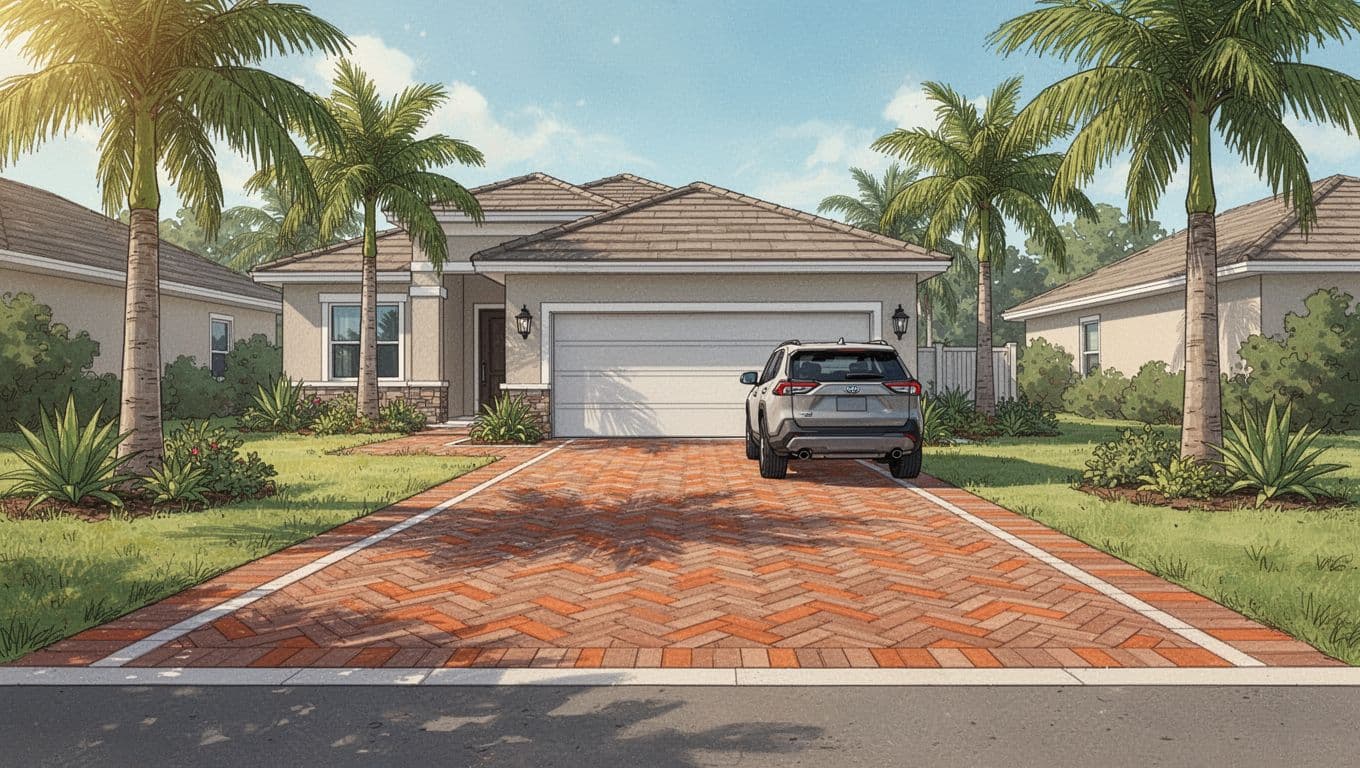
A driveway can have plenty of square footage and still look narrow from the street. Good driveway design considers the property’s proportions, because the pattern, border, color, and paver direction change how wide the surface appears. The wrong layout can make an already tight driveway feel even smaller.
I have spent more than 20 years installing and repairing pavers in Southwest Florida, and I have seen how much the right driveway paver patterns can improve curb appeal. A good layout should complement the home’s architectural style, landscape design, and nearby outdoor living space while handling vehicles and draining properly. Material selection also matters, because porcelain tile pavers must be specifically rated for vehicular driveway use.
Pattern selection is only one part of the overall hardscape design. The sections ahead cover several pattern families, including random modular layouts, but the lasting result depends on what sits underneath. Florida heat, heavy rain, traffic, and the underlying substrate all affect the finished result.
Why Some Paver Layouts Make a Driveway Look Wider
The eye follows lines, so a paver layout can change how wide a driveway feels. Lengthwise borders leading to the garage emphasize length, while crosswise joints can make the surface feel broader. Use both deliberately, and make the field, entry point, garage apron, sidewalk, and street work together.
A narrow driveway often looks wider when the main field stays open, with limited color changes and consistent joints. A random modular field can create visual interruptions on a narrow surface. Too many small pavers, dark bands, or busy borders can break the surface into sections and make it feel tight.
Use the Border as a Frame
A border is one of the most useful hardscape design decisions for changing a driveway’s appearance. I usually recommend a strong border along both sides, with its long edge running in the driveway’s direction. A simple soldier course can frame the field, but it should stay proportionate and visually connect with the driveway edges.
The border should contrast with the main pavers, but it doesn’t need to be dramatically darker. A slight difference in color or texture is often enough. Oversized borders can reduce usable surface area, especially on a short driveway.
The driveway should also connect naturally with the sidewalk, garage apron, and street. A border that stops suddenly or changes direction without a reason makes the entire installation look smaller and less organized.
Keep the Center Field Open
When homeowners want a wider appearance, I avoid placing several narrow stripes through the middle. Those stripes may look attractive in a sample, but they divide the driveway once the full installation is visible.
A broad center field with a simple edge is easier to maintain and usually gives the home a cleaner driveway design. If you want an accent, one cross band near the garage or entry can work well. Multiple bands should have a purpose, not be added only to fill space.
Best Paver Patterns for a Wider Look
Not every attractive paver pattern is a good choice for a residential driveway. Interlocking pavers face turning pressure, braking pressure, and repeated stress near the garage and street. I want the driveway design to balance those demands with the appearance you want.
Herringbone Pattern
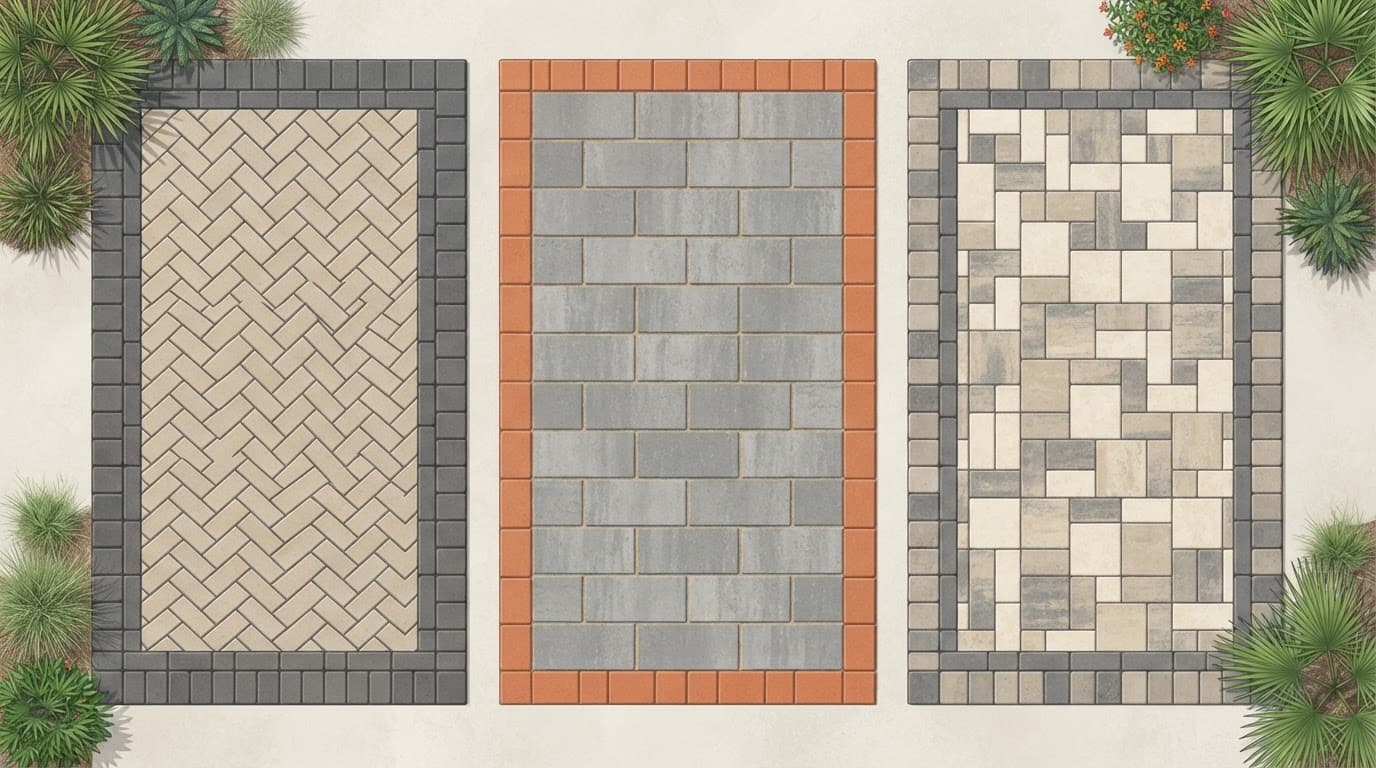
The herringbone pattern is my first choice when strength and vehicle resistance are the main concerns. The pavers form a repeated V-shaped layout, and the interlocking arrangement helps spread loads across the surface instead of allowing individual pieces to move easily.
A 45-degree or 90-degree herringbone layout can work for a driveway when the base and edge restraints are installed correctly. It can suit a home’s architectural style, but several paver colors may make the pattern look busy. I often pair it with one calm body color and a clean contrasting border.
For a wider look, the border can run lengthwise while the herringbone field creates visual movement across the center. This gives the driveway structure without making it look like a long, narrow strip.
Running Bond Pattern
The running bond pattern uses staggered rows, similar to the layout of brick pavers. It has a simple, clean appearance and works well with modern and traditional homes.
The direction of the paver layout matters. When the long joints run straight toward the garage, the driveway may appear longer and narrower. Laying the courses across the width can create a stronger side-to-side effect than some geometric patterns. A random modular alternative may create more visual movement, though the exact choice depends on the paver shape and the driveway’s proportions.
Running bond is easier to plan than a modular layout, and it usually creates less cutting waste. It still needs a stable base because a simple pattern cannot correct poor preparation underneath.
Basketweave Pattern and Stack Bond Pattern
A basketweave pattern alternates small groups of pavers to create a woven appearance. It has a traditional feel and breaks up long sight lines, which can help a narrow driveway look broader.
The stack bond pattern places joints in straight lines, creating a neat grid. It suits contemporary homes, but it doesn’t interlock as strongly as herringbone unless the product and installation system are designed for that use. I wouldn’t choose stack bond as my first option for a driveway with frequent turning or heavier vehicle traffic.
Modular Paver Patterns and the Ashlar Pattern Need More Planning
Ashlar and random modular paver patterns use several paver sizes in a planned combination. They can give a driveway a larger, more custom appearance because the surface doesn’t look like repeated rows of identical pieces. A planned sequence adds the visual interest of geometric patterns without becoming chaotic.
The important word is planned. A modular pattern isn’t random in the sense that you can place pieces anywhere. The sizes normally follow a manufacturer layout or a measured ratio. If the pattern is improvised, the joints can drift, cuts can pile up at the edges, and four corners may meet in one location.
How to Prevent Four Corners From Meeting
When four paver corners meet, they create a weak-looking point and can make the layout appear careless. To prevent it, I use several sizes in sequence and stagger the joints. I check the pattern across a larger area instead of focusing on one small section.
Dry-laying several rows of a random modular layout helps verify the sequence, reveal problems early, and maintain pattern consistency. I also avoid creating long continuous joints that travel across the full driveway. The pattern should move naturally while keeping the edges clean and the border consistent.
Complex layouts can be installed by an experienced DIY homeowner, but the cutting, alignment, compaction, and transitions make them less forgiving. A mistake in the first few rows can affect the entire driveway.
Calculating Material Ratios
For a random modular combination, start with the actual square footage of the driveway field and divide it according to the layout ratio. Use manufacturer coverage data, then account for cuts, curves, and replacement stock when setting the order quantity. Coverage ratios, not individual piece counts, control the number of pavers needed.
For example, a layout with a 2:1:1 area ratio would use approximately:
- 50% of the field in the largest section
- 25% in the second section
- 25% in the third section
The number of individual pavers won’t necessarily follow the same 2:1:1 count because each size covers a different amount of space. Add extra material for cuts, curves, and future replacements, especially when circular patterns create more edge pieces. Straight rectangular driveways usually need less waste than angled or circular patterns.
Build the Pattern for Florida Weather and Traffic
A beautiful driveway design can’t compensate for a base that settles or joints that wash out. Southwest Florida has intense sun, heavy rain, sandy areas, disturbed fill, and drainage challenges that all need attention before the first paver is installed.
Start With the Right Base
For a well-drained residential driveway, the Concrete Masonry and Hardscapes Association lists a compacted base of at least 6 inches as a starting point in base preparation. Wet, weak, or unstable soil may require a different section. Even a random modular layout doesn’t change the base, slope, or edge restraints, which must reflect soil, drainage, and traffic.
The pavers also need to be rated for driveway use, and porcelain tile pavers must have the manufacturer’s approval for vehicular use. The CMHA application guide identifies 2 3/8 inches as the minimum paver thickness for residential driveways. Concrete pavers still depend on product specifications and traffic ratings, especially with large trucks, trailers, or repeated turning traffic. For porcelain tile pavers, the specified base, joints, and drainage system must match the manufacturer’s requirements.
I inspect the subgrade, remove unstable material, place the base in compacted layers, and check the finished elevations during paver installation. Adding loose sand under a rocking paver isn’t a permanent repair. A weak base needs to be rebuilt.
Control Water Before It Causes Movement
Pavers are permeable at the joints, but that doesn’t mean the surrounding drainage can be ignored. Water flowing toward the house, collecting near the garage, or discharging beside the driveway can soften the base and cause settlement.
The CMHA construction guidance explains the importance of proper base construction for interlocking pavers as part of the full pavement system. I also check downspouts, low areas, edge conditions, and the slope leading to the street or drainage system.
Strong edge restraints are just as important for long-term surface stability, along with proper compaction and suitable soil conditions. Without them, the outside pavers can spread, the joints open, and the center field begins to shift. A good pattern needs a solid frame around it.
Choosing Materials for a Florida Driveway
Concrete pavers are popular because they offer many sizes, colors, textures, and pattern options. Damaged pieces can usually be removed and replaced without tearing out the whole driveway, provided the product has an appropriate driveway rating and thickness. That is a major benefit when a paver becomes cracked or badly chipped.
Clay pavers provide the traditional appearance of brick pavers and work well with classic home styles. Natural stone pavers offer more variation in color and texture, but their finish and absorption must suit vehicle use and Florida weather. Some stone products are better for patios or walkways than driveways.
Porcelain tile pavers can look modern and clean, but I don’t treat every porcelain product as driveway material. Products made for paver patio designs may look similar, but porcelain tile pavers still need a manufacturer-approved vehicle rating. Use them only when the manufacturer rates the product and installation system for vehicular traffic. A product designed for an outdoor patio may not handle vehicle loads, turning pressure, or edge pressure.
| Material | Main advantage | Driveway concern |
|---|---|---|
| Concrete pavers | Many colors, sizes, and replacement options | Confirm driveway rating, thickness, and foundation quality |
| Clay pavers | Traditional brick appearance | Color, size, and load rating vary |
| Natural stone | Distinctive texture and natural variation | Finish, absorption, and vehicle rating require review |
| Porcelain tile pavers | Modern appearance and low absorption | Only use a system approved for vehicle loads and turning |
The material should match the pattern, the home, the drainage plan, the budget, and the property’s landscape design. It should support the intended outdoor living space, with thickness, finish, absorption, vehicle loads, turning pressure, and replacement availability reviewed before selection. Choose porcelain tile pavers only when the system has a suitable driveway rating and drainage plan. A material sample alone doesn’t tell you how the finished driveway will perform.
Protecting the Layout After Installation
Joint sand supports interlocking pavers as a system, helping limit movement while keeping weeds and debris from filling the gaps. Florida rain and regular cleaning can remove that sand over time, especially when a narrow pressure-washer nozzle is aimed directly at the joints.
I don’t recommend aggressive pressure washing without knowing the paver material, joint condition, nozzle setting, and distance from the surface. High pressure can chip pavers and blow out the sand the hardscape needs. A controlled cleaning method is safer, and porcelain tile pavers should be cleaned and sealed according to the manufacturer’s instructions.
Sweep the driveway regularly, remove leaves and soil before they collect in the joints, and deal with drainage problems early. Sealing may help with appearance and stain resistance, but it won’t correct a weak base, poor slope, open joints, or sinking section. Those conditions may reflect a paver installation defect, not routine maintenance.
If you notice rocking pieces, spreading edges, open joints, or standing water after rain, have the full area inspected. The visible problem is often only the surface symptom. Get a Free Quote and I can review the pattern, base, edges, and drainage before recommending a repair or replacement.
Frequently Asked Questions
What driveway paver pattern makes a driveway look wider?
A broad center field with a simple border usually makes a driveway feel more open. Crosswise visual movement, controlled color changes, and lengthwise side borders can improve the sense of width without making the layout look busy.
Is herringbone a good pattern for a Florida driveway?
Herringbone is a strong choice because its interlocking layout helps resist movement from turning, braking, and repeated vehicle loads. A calm body color with one contrasting border can provide structure without overwhelming a narrow driveway.
Can a random modular pattern work on a narrow driveway?
A planned modular layout can give the surface a custom appearance and reduce the effect of repeated rows. It requires accurate material ratios, staggered joints, careful cutting, and consistent installation so the pattern doesn’t become crowded or uneven.
How thick should driveway pavers be?
The Concrete Masonry and Hardscapes Association identifies 2 3/8 inches as the minimum paver thickness for residential driveways. The product must still be rated for vehicular use, and the base, drainage, edge restraints, and installation system must match the site’s soil and traffic conditions.
Can a paver pattern fix a driveway that is settling?
A pattern cannot correct a weak or unstable base, poor drainage, or inadequate edge restraints. Rocking pavers, open joints, spreading edges, and standing water usually require inspection of the full pavement system before the surface is reset.
Conclusion
The right driveway paver patterns can make a Florida driveway look wider, cleaner, and better connected to the home. Lengthwise borders, a controlled center field, and a pattern such as herringbone can improve the appearance while supporting regular vehicle traffic.
The lasting result comes from more than the design. Even a random modular layout can’t replace correct construction, including proper paver thickness, a compacted base, stable edge restraints, filled joints, and controlled drainage. If the driveway looks narrow, don’t start by adding more colors or decorative bands. Start with the proportions, then balance the driveway design with traffic needs, drainage, and material selection.