


How to Choose Paver Sizes for a Florida Patio
I recommend planning your furniture layout first, then choosing paver dimensions and thickness for the job. A four-chair dining area generally fits better in a 12 by 14 feet space than in a tight 10-by-12-foot footprint.
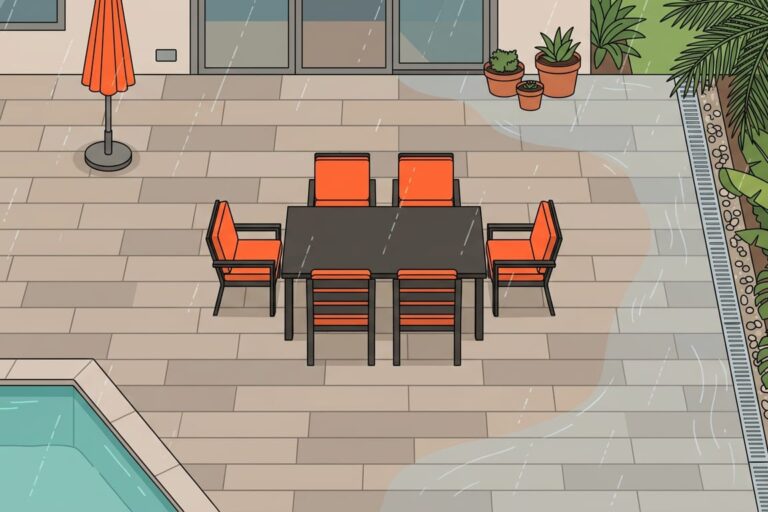
Choosing paver sizes for a Florida patio also means planning for hot surfaces, heavy rain, and sandy ground. Start with the space you need, then give the installation below it the same attention.
Key Takeaways
- Size the patio around furniture, chair movement, and clear walking routes.
- Choose paver dimensions, color, and texture together, especially around pools.
- Budget for a complete installation, including drainage, compacted base, joints, and edge support.
Start With the Patio Footprint
How much room does outdoor dining need?
A 10-by-12-foot paver patio is a practical minimum for a four-chair dining set. A 12-by-14-foot patio gives you 168 square feet and more comfortable chair movement.
I recommend allowing about 36 inches between the table edge and the patio boundary. Add more room where people need to walk behind occupied chairs. A narrow patio can feel crowded even when its total square footage looks adequate.
Our guide to patio dimensions for dining and seating explains how furniture and circulation affect the finished footprint.
What about a complete outdoor living area?
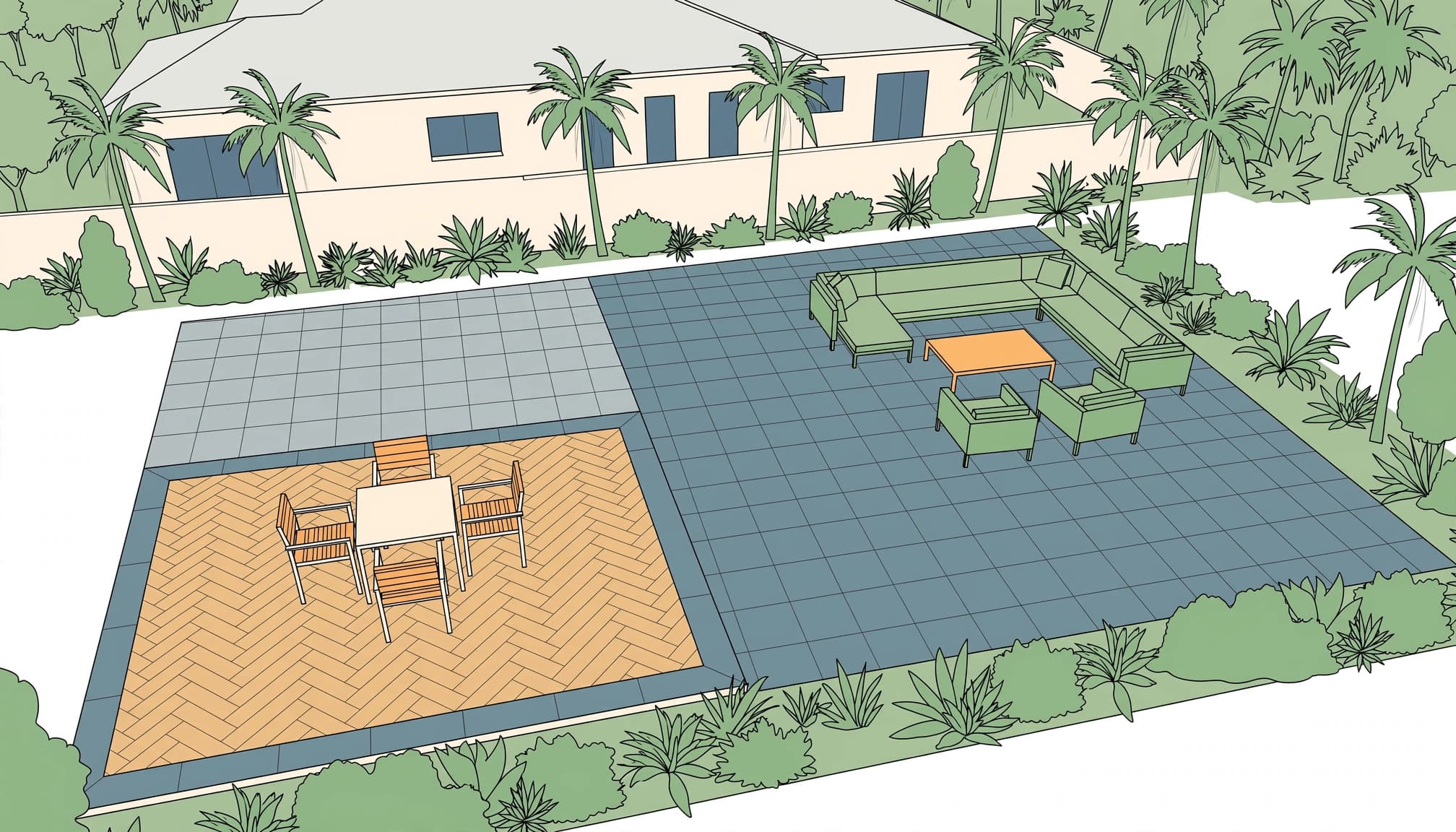
For a sectional, dining area, and fire pit, consider 16 by 20 feet a minimum planning footprint. A 20-by-24-foot layout provides more separation, although fire-feature and screen enclosure clearances still control placement.
Florida backyard patios commonly fall around 200 to 400 square feet. Dimensions such as 12 by 16 or 16 by 24 feet sit near that range. A pool deck can reach 600 to 1,200 square feet, excluding the pool.
Planning a future screen enclosure? Include its footers, door locations, and drainage now so the patio doesn’t need unnecessary rebuilding later.
Which Paver Sizes Suit a Florida Patio?
Small and medium pavers offer layout flexibility
Common options include 4-by-8-inch, 6-by-6-inch, and 6-by-9-inch concrete pavers. These smaller units suit borders, curves, and layouts with several direction changes.
Mixed-size sets can combine 4-by-8, 8-by-8, and 8-by-12-inch units for an ashlar-style layout. I like this approach when you want variation without choosing each piece separately.
Many standard residential concrete pavers are 60 mm thick, about 2 3/8 inches. Thickness and intended use matter as much as face dimensions. Larger slabs and natural stone need their own installation details.
Larger units need room and careful planning
Larger pavers create fewer visible joints and a more open appearance. They work well across broad rectangles, but narrow areas can require awkward cuts.
Plan the border course and main pattern together to avoid thin cuts along the outside rows. Large-format pavers look best when the pattern fits the patio dimensions.
Pattern also changes labor. Running bond generally adds no pattern premium. Herringbone can add $1.50 to $3.50 per square foot, while circles or fans can add $3 to $6. Those additions matter across a large patio.
Match Patio Size to an Installed Budget
These Central Florida standard-paver price examples show how the footprint affects the starting budget.
| Patio dimensions | Actual area | Installed price example |
|---|---|---|
| 10 by 12 feet | 120 sq ft | $1,800 to $2,800 |
| 14 by 18 feet | 252 sq ft | $3,500 to $5,500 |
| 18 by 24 feet | 432 sq ft | $6,000 to $9,500 |
| 24 by 28 feet | 672 sq ft | $9,500 to $15,000 |
Before ordering, confirm the supplier’s required number of pallets and account for cut waste when estimating material quantities.
These examples aren’t equivalent to premium installations with decorative borders or difficult site preparation.
For broader budgeting, allow about $18 per square foot for budget concrete, $25 for mid-tier work, and $38 for premium travertine or porcelain installations. A 300-square-foot patio measuring 20 by 15 feet can run $7,500 to $10,500 with mid-tier pavers and a contrasting border.
I wouldn’t compare those figures without comparing the scope. Small projects still carry delivery, equipment, and setup costs. Poor access, demolition, curves, and drainage work can change the final number substantially.
The pavers themselves can account for only about 20% of the total budget. Excavation, aggregate, compaction, labor, and disposal make up much of the remaining cost. Our Southwest Florida patio pricing guide explains those differences.
Choose Materials for Florida Heat and Pool Use
Light colors help with barefoot comfort
Concrete pavers offer many sizes, colors, and patterns at an accessible price. For exposed patios, I favor lighter blends over dark charcoal or chocolate tones.
Light-colored pavers can run 20 to 30 degrees F cooler than dark options under comparable exposure. Travertine can be about 10 to 15 degrees F cooler than concrete pavers in direct Florida sun.
Those are comparisons, not temperature guarantees. Shade, finish, moisture, and sun exposure still affect comfort. Very pale surfaces can also produce glare and show stains more readily, so color deserves attention beyond the showroom.
Natural stone needs the right finish
Light shellstone and travertine are good choices for Florida poolside areas. Shellstone offers natural shell detail and variation. Travertine generally provides more consistent patterns and broader replacement availability, although matching an older stone lot isn’t guaranteed.
Our shellstone and travertine comparison covers those ownership differences.
I would avoid marble within 4 feet of a pool. Acidic pool exposure can cause visible etching within 1 to 2 years, and damage can happen sooner under harsh conditions. Travertine also needs sensible chemical care. Around water, choose a suitable textured finish rather than relying on appearance alone.
Build the Base and Drainage Together
What belongs underneath the pavers?
For a conventional pedestrian patio, 4 to 6 inches of compacted limerock is a common starting range. A 5-to-6-inch base is often used for foot traffic, compared with about 8 inches for driveways. Soil and loading can require a different design.
Compact the aggregate in approximately 2-inch lifts. Then add the specified bedding layer, pavers, compatible polymeric joint sand, and proper edge restraint. Where pavers meet fixed structures, account for existing expansion joints; the field is flexible, not a rigid slab. The CMHA homeowner pavement guide describes the complete installation process.
Allow roughly $1 to $2 per linear foot for basic edge restraint. It must have firm support; decorative border pavers alone don’t replace it.
Where will stormwater go?
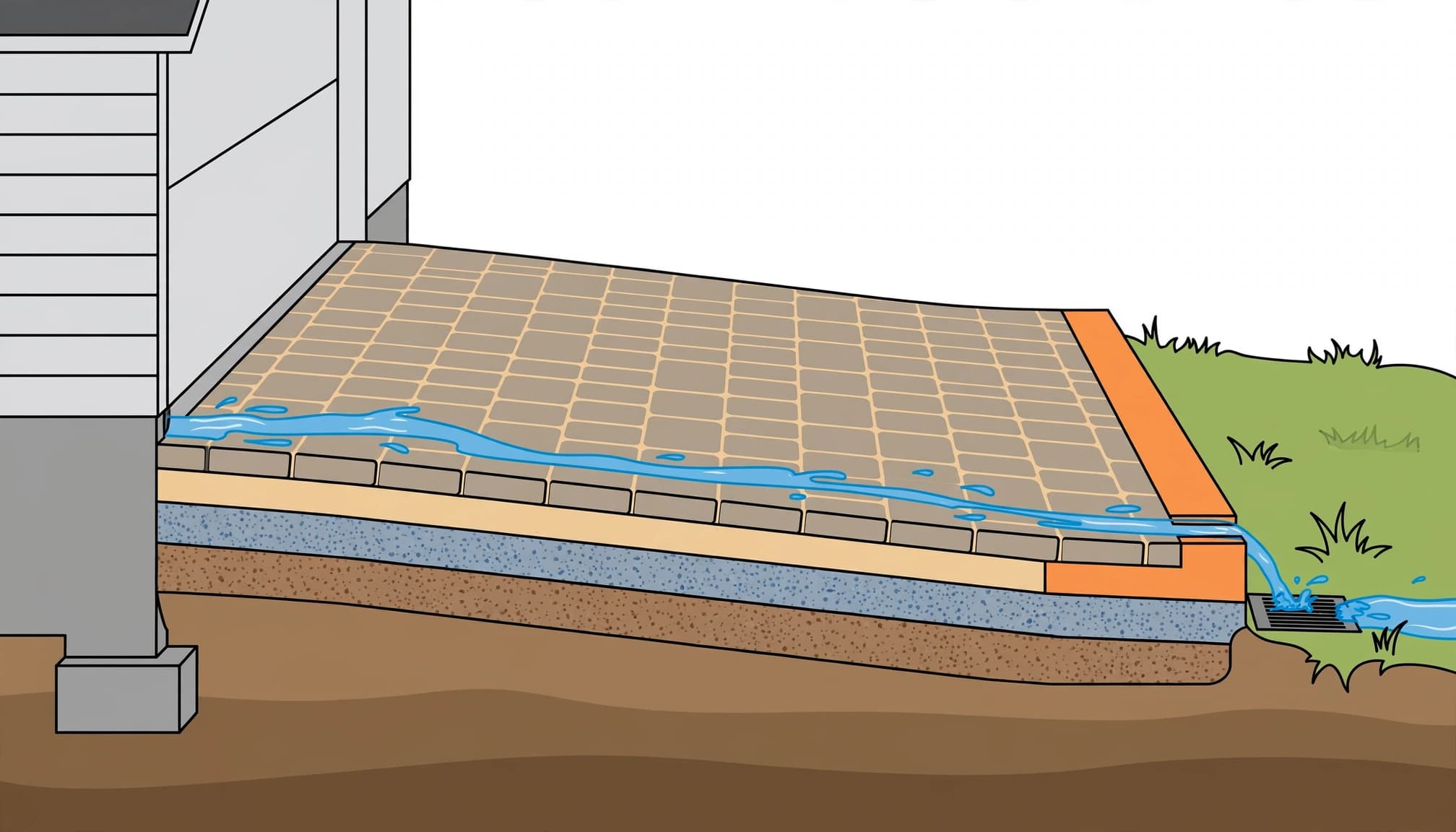
Plan about 1% to 1.5% fall away from the house, approximately 1 inch per 8 feet at the lower end. The surface must drain without creating low spots at doors, enclosure tracks, or pool coping.
French or channel drains may be needed where grading alone isn’t enough. Budget roughly $25 to $60 per linear foot for that additional work.
A permeable patio uses a different aggregate and joint system, as shown in ICPI’s permeable patio guidance. Standard polymeric sand doesn’t belong in joints designed to transmit stormwater.
A larger patio collects more rainfall. Increasing square footage also means planning where that additional runoff will go.
Include Permits, Maintenance, and Quote Exclusions
Permit allowances aren’t a statewide rule
A $75-to-$200 permit allowance is a useful early budget figure where permits are required. The Ocoee-area rule of thumb that detached patios under 200 square feet often need no permit isn’t a statewide exemption.
Setbacks, nearby structures, and drainage changes can affect approval requirements. Check local requirements in Saint Augustine or your own municipality. Polk County’s permitting guidance, for example, addresses pavers within required setbacks or beside structures.
I recommend a written installation scope that identifies approval-related work as well as construction. A small footprint doesn’t remove every zoning or drainage requirement.
Joint care belongs in the ownership budget
Polymeric sand resists washout better than loose joint sand, but it still needs attention. Joint loss can become noticeable after 3 to 5 years. Re-sanding is often budgeted around 5 to 7 years, at approximately $300 to $700 for a 300-square-foot patio.
Loose silica joint sand may need replenishment within 2 to 3 years. Heavy runoff or aggressive pressure washing can shorten either interval, so repair depleted joints sooner rather than waiting for a calendar date.
Quotes often exclude retaining walls, drainage modifications, electrical work, lighting, and structural work for an outdoor kitchen or pergola. For a screen enclosure, confirm whether footers and related work are included. Sealing may also be excluded, sometimes appearing as a year-two expense. I treat sealing as a needs-based choice, not an automatic anniversary requirement.
Paver Patio FAQs
Is a 20-by-20-foot patio a good size?
Yes. At 400 square feet, it offers useful room for dining and seating. Furniture arrangement still determines comfort. Keep the main walking route open, and don’t count required fire-feature clearances as available seating space.
A square layout also gives you flexibility when furniture changes. I would still mark out the actual furniture positions before committing to the paving boundary.
Do pavers really need gravel underneath?
A conventional sand-set patio needs a stable compacted aggregate base, commonly limerock in Florida, beneath its bedding layer. Bare sand isn’t a replacement for that structural support.
I put base quality ahead of decorative upgrades because attractive pavers won’t correct unstable ground. Proper compaction, supported edges, and a clear drainage path work together to reduce settlement and spreading.
Choose the Layout and Build It Properly
For a Southwest Florida paver patio, choose a size that fits your furniture, patio proportions, and maintenance expectations. I recommend choosing the footprint first, then spending the same care on the base, drainage, and edge support.
For your Southwest Florida patio project, Get a Free Quote and contact us for a free consultation and estimate. A clear plan gives you a comfortable patio and a complete understanding of the work underneath it.