


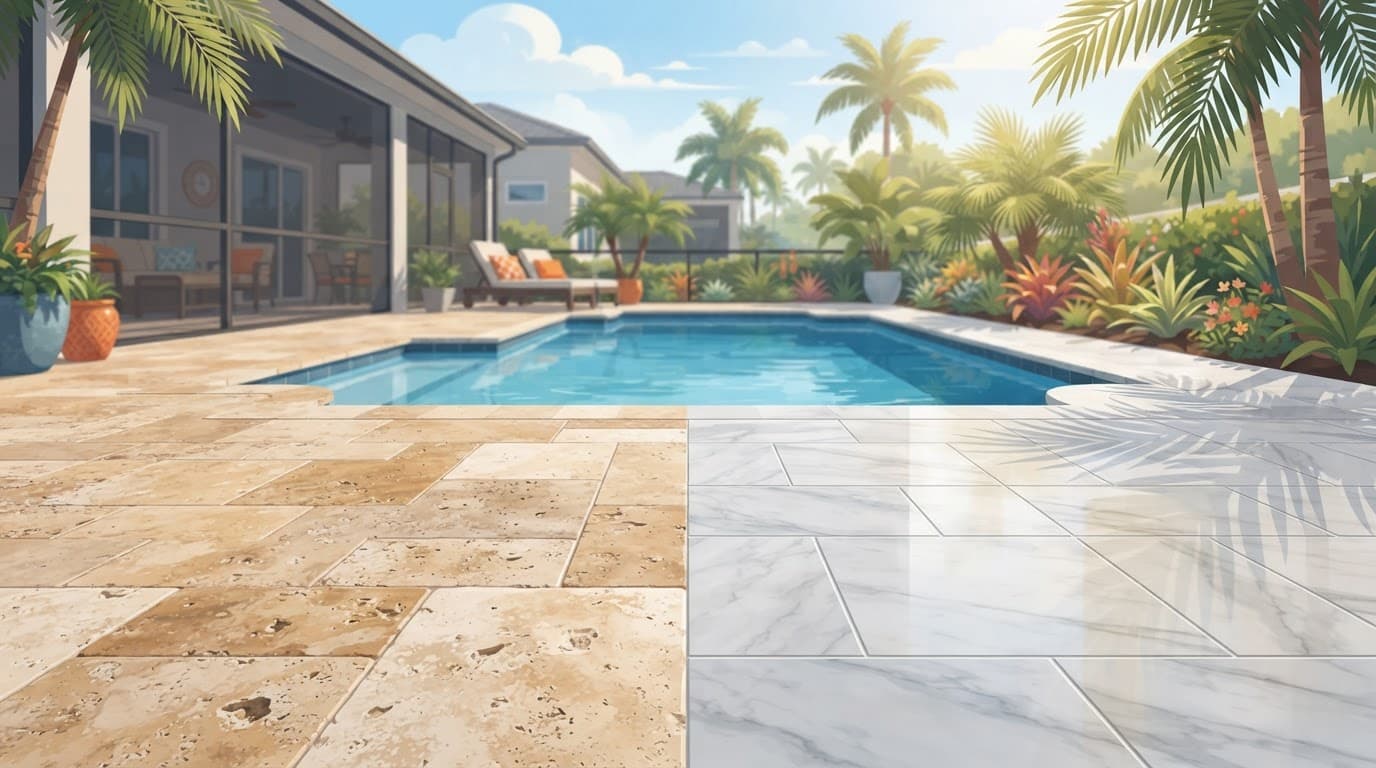
When homeowners compare these two natural stone options, travertine is usually the more practical choice for a Florida pool deck. It typically stays cooler underfoot and performs well in direct sun, heavy rain, humidity, and regular barefoot traffic.
I have seen beautiful stone decks fail because the finish was wrong, the base was weak, or water was trapped underneath. The material matters, but so do the installation, drainage, surface texture, and maintenance plan.
Travertine vs marble: What is the real difference?
Travertine and marble are both forms of natural stone tied to the limestone family, but they aren’t the same material. Their formation differs, affecting how they feel, perform, and hold up around water.
Travertine forms with natural pores and channels
Travertine forms as a sedimentary material when mineral-rich water deposits calcium carbonate around hot springs, caves, and similar environments. Escaping gases and moving water leave behind small holes, pits, and channels.
Those openings make travertine a porous stone. Some pieces are filled at the factory, while others remain unfilled for a more rustic appearance. For outdoor use, travertine tiles are commonly tumbled, brushed, or lightly textured, providing more grip than a polished surface.
Travertine usually comes in warm beige, ivory, cream, walnut, and soft rust tones. Its color variation works well with Florida homes, palms, screen enclosures, and outdoor kitchens. The USGS dimension stone overview also distinguishes travertine deposits from marble formed through metamorphic change.
Marble is denser, smoother, and more polished
Marble is a metamorphic rock created when limestone changes underground under high heat and pressure. The minerals recrystallize, creating the smooth structure found in bathrooms, foyers, marble countertops, and interior walls. That smooth finish also makes marble tiles common in indoor flooring, where conditions are easier to control than in wet outdoor areas.
That contrast also suits the more textured look of travertine countertops. Marble can be white, gray, cream, green, brown, or almost black, depending on its mineral content. Its veining is often more dramatic than travertine’s natural variation.
Marble is usually denser than travertine, but that doesn’t make every marble ideal for wet outdoor areas. A polished surface can become slick when wet, and both stones can scratch or etch because they’re softer than granite. Exact hardness varies by quarry, but these stones commonly fall in the lower range of the Mohs scale.
Which stone stays cooler and safer in Florida?
For Florida’s climate, travertine often has the practical advantage under direct sun. Marble can still work outdoors, but its finish and placement need more attention.
Travertine usually feels cooler underfoot
Travertine has a porous structure and often comes in light colors. Those qualities can limit heat retention compared with many dense, dark surfaces. In my experience, a properly selected travertine installation feels more comfortable for bare feet during a hot afternoon.
That doesn’t mean travertine stays cold all day. A deck in full sun will heat up, while a shaded deck will feel different. Color, thickness, surrounding air movement, and shade from a lanai or screen enclosure all affect surface temperature.
Marble is denser and may have greater heat retention, especially with a dark color or polished finish. White marble can reflect more sunlight, but the surface may still become uncomfortable after hours of exposure.
Texture matters more than the stone name
No material is automatically slip-proof. A textured travertine surface can provide good slip resistance when wet, but a polished surface or heavily filled finish may feel slick. Marble with a polished finish presents an even greater concern around pool water.
For a pool deck, I usually look at tumbled, brushed, or honed finishes instead of polished stone. I also evaluate the slope, drainage, coping transitions, and areas where water tends to collect, since these details affect slip resistance. Standing water creates a safety problem no matter which stone you choose.
Durability, appearance, and daily wear
A pool deck takes more abuse than an indoor floor. People walk across it with wet feet, furniture moves over it, sunscreen gets on the surface, and pool chemicals can leave deposits. Slip resistance also matters when water, sunscreen, and debris collect underfoot.
Travertine handles outdoor use well
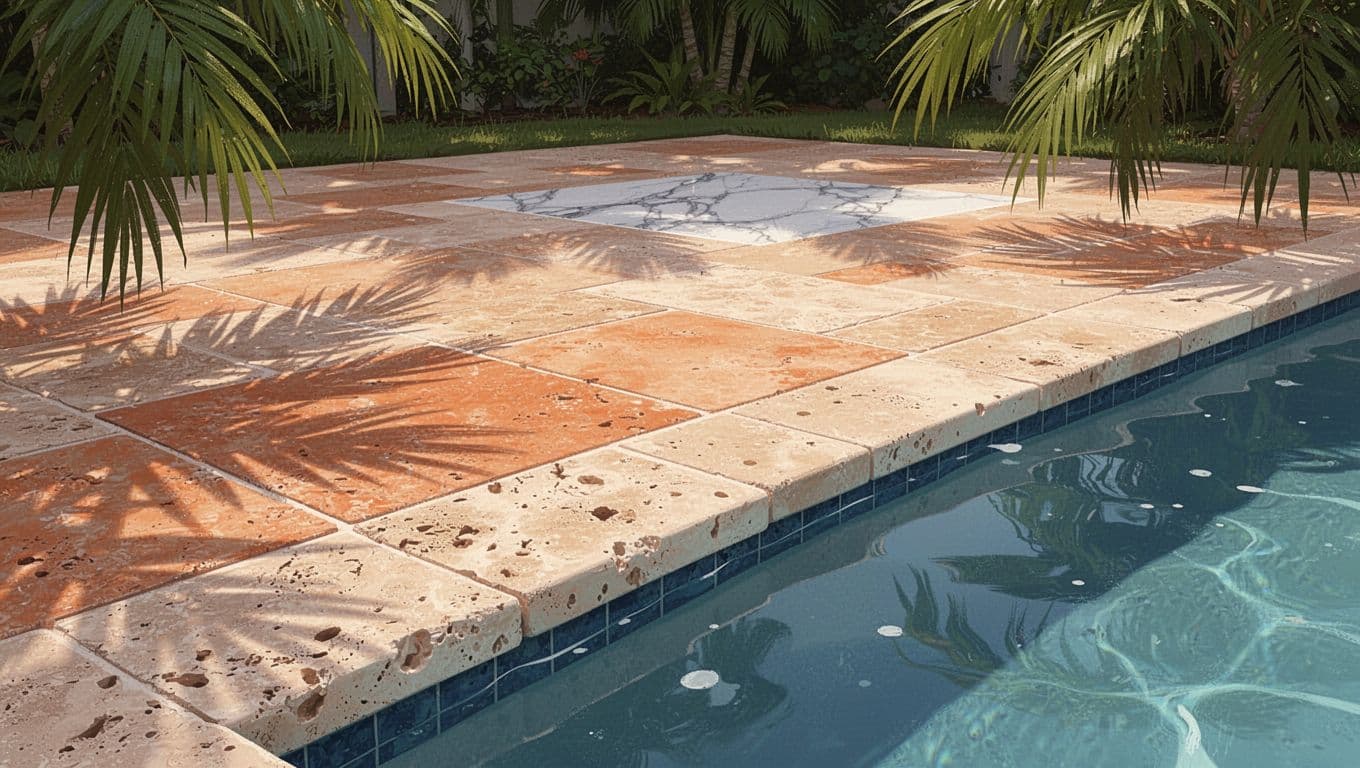
Travertine is a porous natural stone that can perform well outdoors. The durability of travertine depends on its exterior rating, a stable base, and proper compaction. Its natural color variation helps hide small marks and dirt, while texture can improve slip resistance in wet areas.
The main concern is usually movement underneath, not a single paver wearing out. Poor compaction, washed-out bedding material, weak edge support, or drainage problems can cause outdoor pavers to rock, sink, or separate.
If a travertine paver cracks beside a screen enclosure, I don’t look only at the crack. Screen enclosure footings and nearby pavers can settle at different rates after excavation, heavy rain, or soil disturbance. I inspect the footing edge, base, joints, coping transition, and drainage together.
Marble gives a luxury look but shows mistakes
The appearance of marble feels clean and formal, with veining patterns that give coping, steps, and borders a high-end look. It also suits covered outdoor spaces. Marble countertops and travertine countertops may perform well indoors, but outdoor exposure adds water, grit, and chemical concerns.
The tradeoff is that staining and scratching can show more clearly on marble in a busy exterior environment. Acidic cleaners, certain mineral deposits, and improper pool chemical exposure can damage the finish. A polished surface may also lose its shine in a busy outdoor area.
Marble can work outside when it is exterior-rated and finished correctly. I would not choose it for the main wet walking surface if it has a highly smooth finish. A honed finish or textured treatment is better for wet areas. Many homeowners use marble as an accent instead of covering the entire installation.
Maintenance and sealing requirements
Both natural stone options need care, but a travertine pool deck usually demands more attention. Travertine is a porous stone, so its pores can retain moisture, dirt, and stains, increasing its maintenance requirements. Sealing helps, but it doesn’t replace proper cleaning or correct drainage.
A practical travertine care schedule
I recommend sweeping away leaves, dirt, and mulch before they sit on the stone. Rinse the deck with clean water when needed, especially after heavy use or a storm. Use a pH-neutral stone cleaner rather than vinegar, muriatic acid, or household products made for ceramic tile. Products marketed for marble countertops or travertine countertops aren’t automatically safe for an exterior stone surface.
Sealing travertine is often needed every two to five years. The exact schedule depends on the sealer, exposure, traffic, and stone porosity. It doesn’t correct drainage or installation problems. Test a small area by placing a few drops of water on the surface. If the stone darkens quickly, it may be time to have the sealer evaluated.
The Natural Stone Institute care guide provides additional guidance for preventing stains and choosing suitable cleaning products. A penetrating sealer is usually more appropriate for exterior paving than a thick topical coating. Topical coatings sit on top, can become slippery, and may reduce traction.
Avoid acidic cleaners and aggressive pressure washing
Travertine and marble are calcium-based stones, so vinegar, muriatic acid, and other acidic cleaners can cause acid etching. An etched area looks dull, lighter, or uneven instead of simply dirty. Once that happens, cleaning alone may not restore the original finish.
Efflorescence can also appear as a pale mineral crust when moisture moves through masonry or porous materials. I don’t recommend reaching for vinegar just because it is a common household remedy. Acid may damage the stone while leaving the moisture problem untouched.
Pressure washing needs control as well. A narrow, high-pressure nozzle can chip the stone, remove joint material, and wash out the bedding below pavers. The stone maintenance guide from Daltile also recommends using cleaning methods suited to the specific stone and finish.
Cost and installation considerations
Travertine is generally less expensive than premium marble, especially when you compare full-deck installation. The cost of marble rises quickly with rare colors, thick slabs, special cuts, polished edges, and more demanding installation. For travertine tiles, product format, grade, finish, and layout can also affect the final price.
| Material | Typical installed planning range* | Common cost factors |
|---|---|---|
| Travertine pavers | About $12 to $25 per sq. ft. | Stone grade, finish, layout, demolition, base work, coping |
| Marble pavers or slabs | About $20 to $45+ per sq. ft. | Quarry, color, thickness, finish, cutting, edging, installation |
| Site preparation | Added when needed | Excavation, drainage, leveling, soil correction, disposal |
*These are broad planning ranges, not a quote for a specific property.
The price gap between the two materials can shrink when the project needs major base repair or complex drainage work. Natural stone installation pricing also reflects site preparation, demolition, leveling, coping, and base correction. Outdoor pavers need a stable, well-drained foundation, and those improvements can outweigh the initial material-price difference.
Prices for marble countertops and travertine countertops aren’t direct benchmarks for exterior paver installation. Indoor fabrication and outdoor base work involve different cost drivers.
A cheap surface installed over a weak foundation isn’t a good value. If water is washing out the base, the stone will move again no matter how expensive it was.
I also watch the area around screen enclosures. Minor paver resetting may not require a permit, but changing a structural footing or enclosure anchor can. Check with your local building department before altering the enclosure, and don’t drill into the footing or move screen posts without professional guidance.
Which material makes the better Florida pool deck?
For most homeowners in Fort Myers, Cape Coral, Bonita Springs, Punta Gorda, Sarasota, and nearby areas, I recommend travertine for the main outdoor area. It usually stays more comfortable under the Florida sun, offers better texture options for wet areas, and provides a warm outdoor appearance at a lower cost than high-end marble.
Travertine is the practical choice
Choose travertine when you want a full deck that feels natural, works with Florida architecture, and remains comfortable for regular barefoot use. Tumbled or brushed finishes are usually better than polished finishes.
When sealing travertine, use a product intended for exterior natural stone. The installation still needs a compacted base, proper slope, stable edges, and clear drainage. If pavers sink, rock, or develop widening joints, I correct the support below before sealing the surface.
Marble works best as a controlled feature
Choose marble when luxury appearance matters most and you accept higher maintenance requirements, including careful cleaning and finish management. Marble can look excellent on coping, steps, borders, covered patios, or decorative accents. Homeowners who love marble countertops should remember that outdoor wet areas have different performance demands.
I’d use an exterior-rated marble with a honed finish in wet areas, since glossy finishes can reduce slip resistance. Never assume a shiny finish is safe, and confirm that the selected stone is suitable for outdoor exposure. If you want the stone, base, enclosure edge, and drainage reviewed together, Get a Free Quote for a local consultation.
Frequently Asked Questions
Is travertine better than marble for a Florida pool deck?
For most Florida pool decks, travertine is the more practical choice because it typically feels cooler and offers better textured finish options. Marble can work in select areas, but it usually needs more careful placement and maintenance.
Does travertine become slippery when wet?
Travertine is not automatically slip-proof, but tumbled, brushed, or lightly textured finishes can provide useful traction around pool water. Proper slope and drainage also matter because standing water can create a safety problem on any stone surface.
How often should a travertine pool deck be sealed?
Travertine often needs sealing every two to five years, depending on its porosity, exposure, traffic, and the sealer used. Sealing helps reduce staining and moisture absorption, but it does not correct poor drainage or movement in the base.
Can marble be used outdoors around a pool?
Exterior-rated marble can work for coping, steps, borders, covered patios, or other controlled features. I would avoid highly polished marble on the main wet walking surface because it can become slick and may show etching or scratches more clearly.
What matters more than choosing travertine or marble?
A stable, well-compacted base, proper drainage, secure edges, and the correct surface finish often determine the long-term result. Even expensive stone can sink, crack, or separate when water is trapped underneath or the supporting base is weak.
Conclusion
The better choice for most Florida installations is travertine. It stays cooler underfoot, offers useful texture and natural color, and costs less than premium marble. Marble can still suit select projects, but it needs the right finish, careful placement, and closer attention to etching and traction.
The biggest mistake is evaluating natural stone without checking what supports it. A stable base, controlled drainage, proper edge support, and professional sealing determine the long-term result more than choosing the most expensive material.